
10 Signs Your Manager Is Quietly Pushing You to Resign
Introduction
It usually doesn’t happen in one day. Nobody calls you into the room and says, “We want you to leave.” Instead, small things change. The smile disappears. The meetings stop. The work you loved is given to someone else. And one day you sit at your desk and wonder, “What did I do wrong?”
If you are reading this with a heavy heart, you are not alone. Many hard-working people have felt this quiet pressure, and it hurts in a way that is difficult to explain. It is not a loud fight. It is a slow feeling of not being wanted.
In this guide you will learn the 10 signs that a manager may be quietly pushing you to resign, how each one feels, and what you can do. Most importantly, you will learn that your value is bigger than one manager’s behavior.
| Please read this first These signs do not prove that your manager wants you to leave. Some may happen because of stress, restructuring, or poor communication. Look for patterns that repeat over weeks or months, not a single bad day. Always stay calm and gather facts before you decide. |
| “In my experience as an HR professional, I have seen talented employees leave organizations not because of a lack of opportunities, but because of poor management practices. Sometimes, employees deliver quality work on time and receive recognition directly from senior management. Instead of appreciating their performance, insecure managers may perceive their achievements as a threat. They begin to restrict their autonomy, create unnecessary pressure, question their work without valid reasons, and make the workplace increasingly stressful. Eventually, these employees choose to resign—not because they lack commitment or ability, but because they no longer feel valued, trusted, or supported. A good manager creates opportunities for talented people to grow. An insecure manager creates reasons for them to leave. Organizations must understand that losing talented employees due to poor management is a leadership failure, not an employee retention problem. |
Why This Hurts So Much
Work is not only about salary. It is where we spend most of our day, build our identity, and feel useful. When someone you depend on slowly pulls away from you, your mind looks for a reason, and it often blames you.
That is why quiet pressure is so painful. There is no clear event to point to, no one to argue with, and no proof to show. Just a feeling that something is wrong. If you feel sad, anxious, or angry, those feelings are valid.
The 10 Signs
Sign 1: Sudden silence and distance
What it looks like: You used to get a good morning and a quick chat. Now your manager barely looks at you, replies in one word, or goes quiet when you enter the room.
How it feels: The silence feels loud. You start replaying every conversation, asking yourself what you did wrong. That constant guessing is exhausting.
What may be happening: Silence can be a way to avoid an honest conversation. Some managers pull back from people they have already decided to “let go” without saying it.
What you can do: Ask for a short one-to-one. Say calmly: “I’ve felt a change recently. Is there anything I should know or improve?” A direct question is hard to ignore.
Sign 2: Your work is slowly taken away
What it looks like: Projects you owned are given to a colleague. Your clients, your reports, your responsibilities shrink month after month, and nobody explains why.
How it feels: It feels like being erased from your own job. You may start to doubt your skills, even if you were doing well.
What may be happening: Reducing your role quietly makes the job feel pointless, so that leaving seems like your own idea.
What you can do: Write down what you handled six months ago and what you handle now. Then ask your manager about the change in a neutral tone.
Sign 3: Impossible targets and shrinking deadlines
What it looks like: Your targets suddenly double. Deadlines move without notice. Others get time and support, but you get pressure.
How it feels: You work late, skip meals, and still hear “not enough.” The tiredness is physical, and the guilt is emotional.
What may be happening: Setting someone up to fail creates a “reason” for negative feedback or a poor review later.
What you can do: Ask for priorities in writing: “Which of these three tasks is most important this week?” It protects you and shows your effort.
| I have seen employees who consistently delivered good results suddenly receive unrealistic targets or have their responsibilities reduced without any valid explanation. Instead of receiving guidance and support, they were put under unnecessary pressure and made to feel that their efforts were never enough. Over time, their motivation declined, workplace stress increased, and they eventually chose to leave the organization. It was a clear example of how poor leadership can push valuable talent out of a company. |
Sign 4: You are left out of meetings and decisions
What it looks like: You find out about meetings after they happened. Emails that include your whole team somehow skip you.
How it feels: Being left out is one of the loneliest feelings at work. You feel like a guest in your own team.
What may be happening: Exclusion removes your visibility and influence, a quiet way of showing that you are no longer wanted.
What you can do: Politely ask to be included: “I noticed I wasn’t on yesterday’s invite. Could you add me for future meetings on this project?” Keep the message in writing.
Sign 5: Constant criticism, no praise
What it looks like: Small mistakes are pointed out in front of others. Your wins are ignored, or credited to someone else.
How it feels: Every message becomes a threat. You hold your breath before opening emails, and your confidence slowly wears down.
What may be happening: Constructive feedback is specific and respectful. Criticism that is only negative, public, and constant is pressure, not coaching.
What you can do: Ask for examples: “Could you show me what a good result looks like?” Save positive feedback from clients and colleagues as proof of your value.
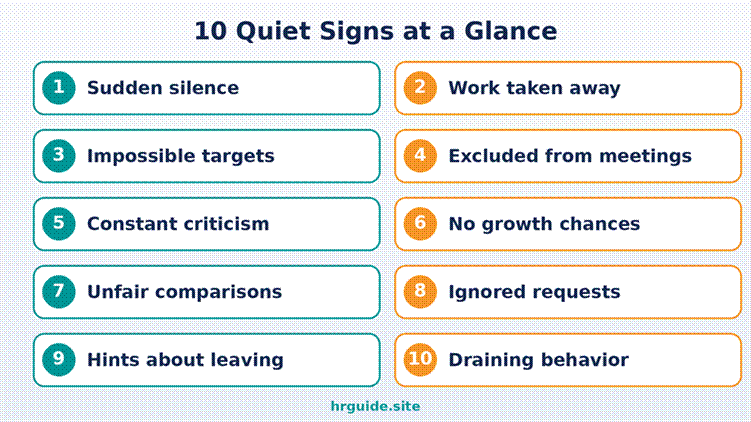
Sign 6: Growth chances suddenly disappear
What it looks like: The training you asked for is “not approved.” Promotions, raises, or new projects go to others, even when you earned them.
How it feels: You feel stuck, as if the door to your future has been closed without anyone telling you.
What may be happening: Blocking growth can push a person to look for opportunities elsewhere.
What you can do: Ask for a clear growth path: “What do I need to achieve to reach the next level, and by when?” Get the answer in writing.
Sign 7: Unfair comparisons with colleagues
What it looks like: “Why can’t you be like him?” Your work is measured against people with different roles, workloads, or experience.
How it feels: Comparison makes you feel small. It turns teamwork into competition and leaves you with hurt that doesn’t go away.
What may be happening: Unfair comparison damages your self-worth, so you begin to believe you don’t belong.
What you can do: Respond with facts, not feelings: “We have different workloads. Can we agree on measures that apply to my role?”
Sign 8: Your requests and concerns are ignored
What it looks like: Leave requests are delayed. Emails stay unanswered. When you raise a problem, you hear, “That’s your issue.”
How it feels: You feel invisible. Being ignored sends a quiet message: you do not matter.
What may be happening: Ignoring is a form of control. It makes you feel powerless and tired of asking.
What you can do: Follow up politely in writing and keep copies. If nothing changes, a calm note to HR is the next step.
Sign 9: Hints and jokes about leaving
What it looks like: “Maybe this job isn’t right for you.” “Have you thought about other options?” Sometimes it sounds like a joke, sometimes like advice.
How it feels: Each hint is a small cut. You start asking yourself if you should quit before you are asked to.
What may be happening: Hints let a manager push without saying anything that can be questioned. This is the clearest sign of all.
What you can do: Don’t react in anger. Reply calmly: “Is there a concern about my performance I should know about? I’d like to understand it.”
Sign 10: Your energy, health, and confidence are draining
What it looks like: You dread Monday. You cannot sleep. You feel anxious before meetings, or sad for no clear reason. Even good days feel heavy.
How it feels: This is the sign that matters most. When work harms your body and mind, it is serious, whatever the cause.
What may be happening: Long-term stress at work can affect sleep, mood, and health. You deserve a workplace that does not make you smaller.
What you can do: Talk to someone you trust, such as a friend, family member, or doctor. If you feel overwhelmed, please seek professional support. You do not have to carry it alone.
Is It Them, or Is It Me? (A Quick Self-Check)
Before you decide anything, ask yourself these honest questions:
- Have my results really dropped, or only the way they are treated?
- Did the company recently change structure, budget, or leadership?
- Have I received clear feedback, written or spoken, about what to improve?
- Is this behavior only with me, or with others too?
- Has it continued for weeks, not just one bad day?
If you answered “only with me” and “for weeks,” it is time to act calmly and carefully. If there is feedback you have not yet heard, ask for it. Sometimes the problem is poor communication, not bad intent.
7 Steps to Protect Yourself
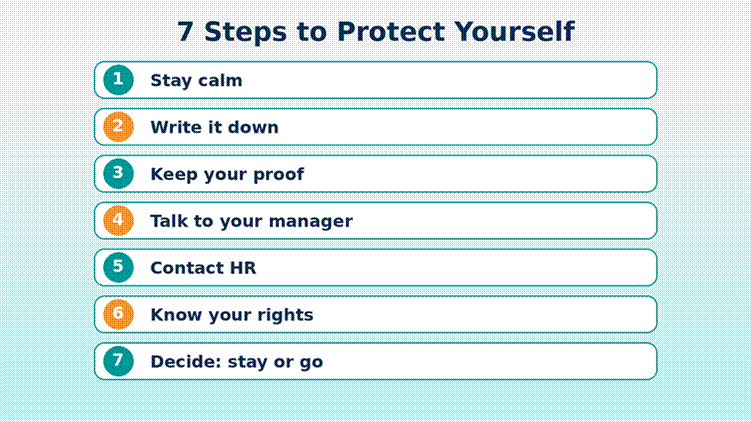
Step 1: Stay calm and don’t react in anger. Strong emotions are natural, but a calm reply protects your reputation and your options. Take a walk, breathe, and sleep on it before you respond to anything.
Step 2: Write it down. Keep a simple diary with the date, what happened, who was present, and how it affected your work. Stick to facts, not opinions.
Step 3: Keep your proof. Save emails, messages, appraisal reports, and praise from clients. Store them safely, following your company’s data rules.
Step 4: Talk to your manager directly. Request a private conversation and ask for clear feedback. Use polite words such as “I want to improve. Can you help me understand?”
Step 5: Contact HR or a senior leader. If nothing changes, share your concern with HR in writing, with facts and dates. Ask what the process is, and stay professional.
Step 6: Know your rights. Labour laws are different in each country. Many places protect employees from forced resignation, unfair treatment, or “constructive dismissal.” Check your contract, the company policy, and local law, or ask a qualified employment lawyer or union.
Step 7: Decide: stay or go. Take time to decide with a clear mind, not in the middle of a bad day. See the guide below.
| I have seen employees who consistently delivered good results suddenly receive unrealistic targets or have their responsibilities reduced without any valid explanation. Instead of receiving guidance and support, they were put under unnecessary pressure and made to feel that their efforts were never enough. Over time, their motivation declined, workplace stress increased, and they eventually chose to leave the organization. It was a clear example of how poor leadership can push valuable talent out of a company. |
Stay or Leave? How to Decide
There is no single right answer. Staying is not weakness, and leaving is not failure. What matters is that you choose with a clear mind, not out of fear.
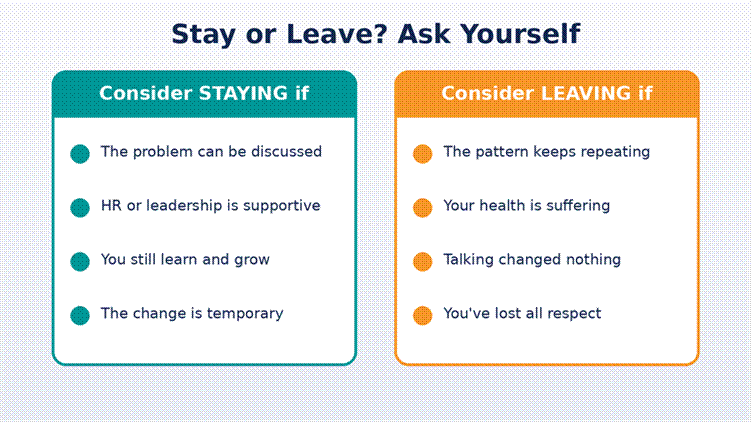
If you decide to leave, do it on your terms. Start looking for a new job quietly, update your CV, speak to trusted contacts, and keep working professionally. If you resign, write a short, polite letter, return company property, and ask for your experience letter and dues. Leaving with dignity protects your name for the future.
Protecting Your Mind While You Decide
- Talk to someone you trust. Carrying this alone makes it heavier.
- Keep your routine: sleep, meals, and a little movement each day.
- Remember your achievements. Write down five things you are proud of.
- Set work boundaries, for example, no work emails late at night.
- If you feel hopeless or unable to cope, please speak to a doctor or a mental health professional. Asking for help is a strength.
A Message to Anyone Reading This with a Heavy Heart
If you have felt unwanted at work, please remember: one manager’s behavior does not define your skills, your effort, or your future. Many strong careers have started after a very painful chapter.
You showed up, worked hard, and tried your best. That matters. Take care of yourself first, then make your next decision with courage and calm.
Frequently Asked Questions
What is quiet pressure to resign?
It is when a manager makes work uncomfortable through silence, exclusion, extra pressure, or hints so that an employee leaves without being formally fired.
Is it legal for a manager to push someone to resign?
It depends on the country. In many places, forcing an employee to quit through unfair treatment can be treated as constructive dismissal. Check your local labour law or speak to an employment lawyer.
Should I resign immediately if I notice these signs?
Not usually. First gather facts, talk to your manager, and consider speaking with HR. Resigning too early may reduce your options, such as claims or dues.
How do I talk to my manager without making it worse?
Stay calm, use facts, and ask for feedback. For example: “I want to do my best. Could we discuss how my work is going?”
What if HR does not help?
Keep your records, check your company grievance procedure, and consider outside advice from a lawyer, union, or labour department.
How do I stay emotionally strong?
Lean on friends or family, keep your routine, remember your achievements, and seek professional help if the stress feels too heavy.
Conclusion
Quiet pressure at work is hard because it leaves so many questions and so little proof. But you are not powerless. By noticing the signs, writing things down, asking calmly for clarity, and protecting your health, you take back control.
Whether you stay and fix things, or leave and begin again, remember that your worth never depended on one person’s approval.
| If you are going through this situation right now, remember that your worth is not defined by an insecure manager or a toxic workplace. Never let someone else’s behavior make you doubt your talent and abilities. Sometimes, leaving an unhealthy environment is the beginning of a better opportunity. Have you ever felt pushed out of a job despite giving your best? Share your experience in the comments. Your story might help someone who is facing the same situation today. |

About Muhammad Faisal
Muhammad Faisal is an HR professional with an MBA in Human Resources and six years of experience across diverse HR domains. Through HRGuide.site, he turns real-world HR knowledge into practical insights, career advice, interview tips, and valuable resources to help professionals grow and organizations thrive.