Compensation and Benefits in Pakistan: PESSI, EOBI, WPPF, Education Cess and PWWB Education Explained
Compensation and Benefits in Pakistan: PESSI, EOBI, WPPF, Education Cess and PWWB Education Explained
Every month, a worker looks at the payslip and sees one number: take-home pay. Behind that number sits a quieter promise: if I get sick, injured, old, or die, my family will not be left with nothing.
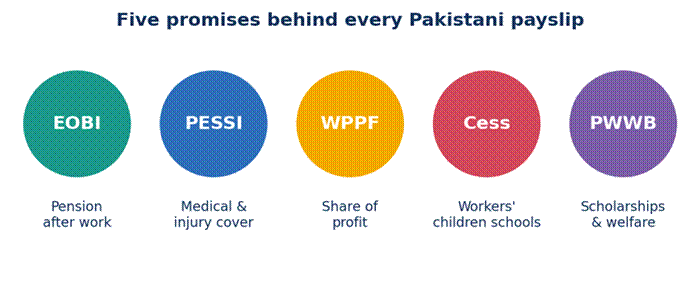
That promise lives in five names most employees have heard but few understand: PESSI, EOBI, WPPF, Education Cess and PWWB. If you work in HR, payroll or management, explaining them well is part of your job. If you are an employee, knowing them is part of protecting your family.
This guide explains each one in plain language.
| In my company a Employee does not know about Eobi he shared his problem with me he says that next month his daughter’s marriage and he get loan from bank for his daughter’s marraige so i tell him that he has 5 year service in Industry and according to EOBI a employee get Marriage grant of his daughter he applied for marraige grant and after some time he got A handsome amount of 4 Lac it was a great help of employee. |
What does “compensation and benefits” really mean?
Compensation is what you are paid: salary, overtime, bonus. Benefits are what stand behind you: medical cover, pension, a share in profit, and support for your children’s education.
In Pakistan, many of these benefits are set by law, not by employer goodwill. The employer must register, deduct and deposit. The worker is entitled to claim.
1. EOBI: your pension after you stop working
The Employees’ Old-Age Benefits Institution (EOBI) is a federal pension scheme. It pays old-age pension, invalidity pension, survivor’s pension and old-age grant to registered workers.
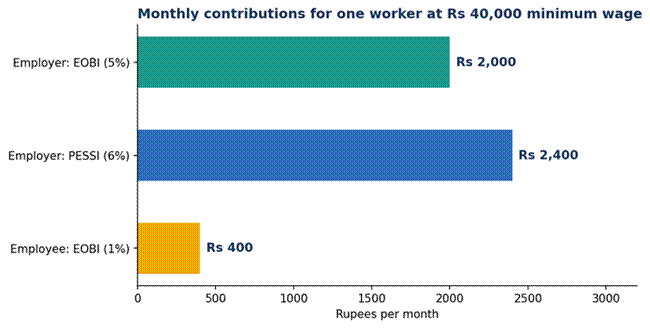
How much is paid? Both contributions are calculated on the minimum wage, not on your actual salary. The employer pays 5% and the employee pays 1%.
- At a minimum wage of Rs 40,000: employer Rs 2,000, employee Rs 400, total Rs 2,400 per month.
- The employer deducts the employee’s Rs 400 from salary and deposits both shares.
HR tip: Your highest-paid employee and your lowest-paid employee generate the same EOBI contribution. Do not skip registration for senior staff, because the pension right belongs to them as well.
2. PESSI: medical care and protection in Punjab
The Punjab Employees Social Security Institution (PESSI) covers workers in notified establishments in Punjab. It runs its own hospitals and dispensaries and provides:
- Medical treatment for the worker and family
- Maternity benefits
- Injury and disablement benefits
- Death grant and survivor’s pension
- Funeral grant and artificial limbs
- Free education for the children of insured workers
How much is paid? The employer contributes 6% of wages up to a ceiling. Punjab notified the ceiling as equal to the minimum wage of Rs 40,000, so the maximum employer contribution is Rs 2,400 per worker per month.
An important point: Employees earning above the ceiling can fall outside the definition of “worker”. PESSI’s position is “once covered, always covered”. If you manage payroll, confirm the position for each employee with PESSI instead of assuming.
| Last year our an employee admit in Pessi hospital due to an accident the hospital checked the employement card and pessi card admit him start treatment and all procedure was free it was a great experience the staff was very cooperative and helpful pessi is a great benifit. |
3. WPPF: a share of the profit
The Workers’ Profit Participation Fund (WPPF) comes from the Companies Profits (Workers’ Participation) Act, 1968. Sindh and Balochistan have their own versions of the law.
- A qualifying company sets aside 5% of its profit every year.
- The money is meant to be shared among eligible workers.
- Because the law has a wage ceiling for who counts as a worker, a large part of the 5% often goes to the Workers Welfare Fund (WWF) instead of to employees.
This is why many employees say, “Our company made a profit, but I never received anything.” WPPF is separate from the 2% WWF levy that companies also pay.
For employees: Ask HR whether your company is liable under WPPF, and whether you fall within the eligible wage category.
For HR: Explain the rule openly. Silence creates suspicion, and clear communication builds trust.
4. Education Cess: money meant for workers’ children
The Workers’ Children (Education) Ordinance, 1972 applies to establishments that employ ten or more workers. The employer pays an education cess, historically Rs 100 per worker per year in Punjab. The social security institution collects and administers it. The purpose is to fund schooling for workers’ children and improve schools attached to industrial units.
Honest note for HR: Over the years, the cess has been debated and at one point was reported as withdrawn in Punjab. Before you include it in your budget or tell staff it is payable, confirm the current status with PESSI.
5. PWWB / PWWF: education support from the welfare fund
The Punjab Workers Welfare Board (PWWB), which runs the Punjab Workers Welfare Fund (PWWF), was created under the Workers Welfare Fund Ordinance, 1971. It is financed largely through employer contributions from registered factories and mines.
Its education support for workers’ children includes:
- Talent scholarships for children of registered industrial workers and miners
- Labour quota seats at universities. For Fall 2026, PWWB offered a fully funded scholarship at COMSATS campuses covering tuition, hostel and transport.
- Free-education seats at institutions such as Government College University, Lahore
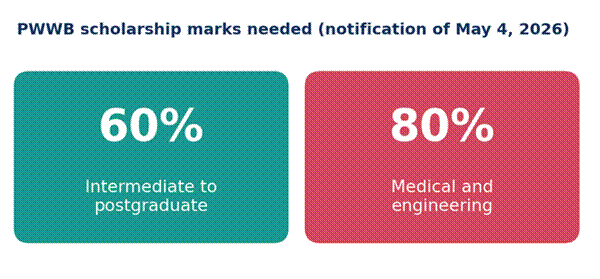
Rules changed in 2026. A May 4, 2026 notification requires at least 60% marks from intermediate to postgraduate level and 80% for medical and engineering programmes. The self-education scheme for workers and their spouses was discontinued from April 6, 2026. Labour leaders criticised the new criteria as unrealistic. Claims submitted before April 6 are processed under the old rules.
Practical advice: Your employer must be a qualifying establishment under the WWF Ordinance or the WPPF Act for your child to be eligible. Ask HR whether the company is registered, and keep your child’s results and your employment records ready.
| Once our employee comes to me and said that his son’s scholorship not approved i checked and see in his file factory registration and last three months contribution slips were missed as an hr person i add and complete the file he submit again and his son’s admission successfully granted. |
Quick comparison table
| Benefit | Who runs it | Who pays | Main purpose | Who benefits |
| EOBI | Federal | Employer 5%, employee 1% of minimum wage | Old-age and survivor pension | Registered employees and families |
| PESSI | Punjab | Employer 6% of wages up to ceiling | Medical, maternity, injury, death benefits | Insured workers and families |
| WPPF | Federal / provincial law | Company, 5% of profit | Profit share | Eligible workers |
| Education Cess | Social security institution | Employer, per worker (verify status) | Workers’ children’s education | Children of workers |
| PWWB / PWWF | Punjab Labour Dept. | Employer contributions to welfare fund | Scholarships and welfare | Children of registered workers |
Example: one worker at the minimum wage
Take a worker in Punjab earning Rs 40,000 a month:
- EOBI: employer Rs 2,000 and employee Rs 400
- PESSI: employer Rs 2,400
- Employer’s monthly cost on top of salary: about Rs 4,400
- Employee’s deduction for EOBI: Rs 400
Add the yearly WPPF provision and any education cess, and the full cost of one employee is clearly higher than the salary on paper. Good HR planning counts all of it.
HR checklist for compliance
- Register every eligible employee with EOBI and PESSI.
- Deposit contributions every month, on time.
- Keep payroll records matching your registers.
- Tell employees what is deducted and why.
- Check the minimum wage notification every July and update contribution amounts.
- Confirm your company’s WPPF and WWF position with your accountant each year.
- Help workers apply for PWWB scholarships and keep copies of documents.
Frequently asked questions
Is EOBI deducted from my actual salary?
No. The calculation uses the minimum wage, so the deduction is fixed regardless of your salary.
Can I get PESSI treatment if I earn above the ceiling?
It depends on your coverage status. Ask your HR and the PESSI office.
Does every company pay WPPF?
Not every company is liable. It depends on the law that applies and on whether there is profit.
Can my child get a PWWB scholarship?
Possibly, if your employer is a qualifying registered establishment and your child meets the current marks criteria.
Final thought
Salary pays the bills this month. EOBI, PESSI, WPPF, the education cess and PWWB are meant to protect the years you cannot yet see: sickness, old age, your children’s classrooms. Employers who handle them honestly are not just following the law. They are keeping a promise to the people who built the company.
| I observed many companies did not give awarness to his employees just for the documentation work many IR officers just ignore but as hr person i always tell them about these benifitst because my little effor can give a girl marriage support a Students free admission and a needy person hospital support. |
Disclaimer: This article is for general information, not legal advice. Rates and rules change, so please confirm with PESSI, EOBI and the Punjab Labour Department.

About Muhammad Faisal
Muhammad Faisal is an HR professional with an MBA in Human Resources and six years of experience across diverse HR domains. Through HRGuide.site, he turns real-world HR knowledge into practical insights, career advice, interview tips, and valuable resources to help professionals grow and organizations thrive.