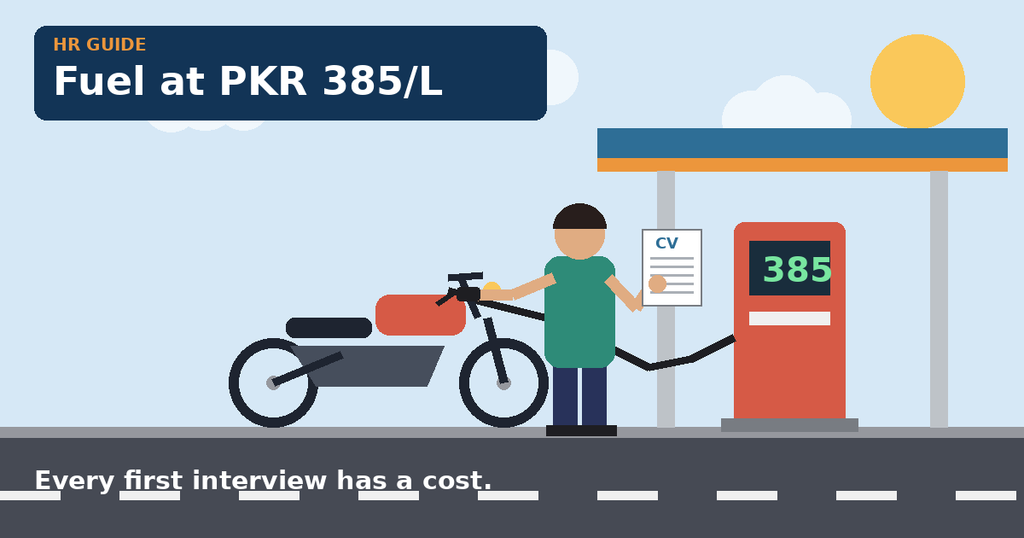
Fuel at PKR 385/L — Is a First Interview Worth the Cost?
Should the first interview be online? Read what recruiters and job seekers in Pakistan say about screening calls, travel costs and respectful hiring.
By HR Guide | Candidate Experience, Hiring Practices, Job Search in Pakistan
Picture this. You are unemployed, and an invitation arrives for an on-site interview. You borrow money for fuel or a cab, take a day off from your search, and travel across the city, or across the country. You sit in a waiting area, and fifteen minutes later you are heading home with no idea whether you were even a fit.
For thousands of job seekers, this is not a story. It is a routine. Behind every CV is a person with bills, family responsibilities and a lot of hope. And right now, with fuel prices where they are, that hope costs real money.
A recent LinkedIn post by Muhammad Faisal, an HR professional, asked a simple question that struck a chord with hundreds of people: should the first interview really require a physical visit? This article looks at what the post said, and more importantly, what professionals from across the hiring world had to say about it.
The Hidden Cost of a “Quick” First Interview
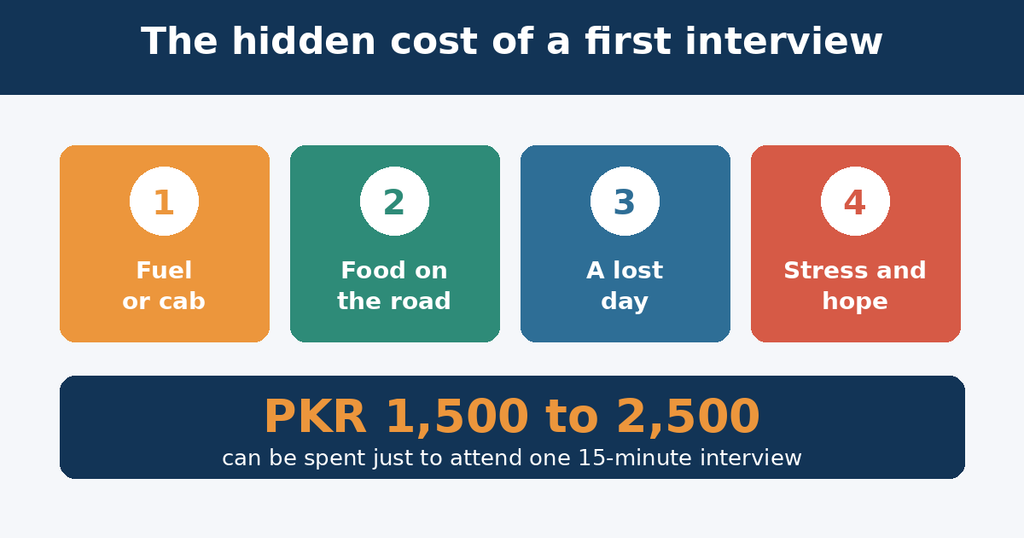
The post pointed out that a candidate can spend roughly PKR 1,500 to 2,500 just to attend a short initial interview. That figure does not include the lost day, the stress, or the emotional weight of hoping for a result.
For someone who is already out of work, that money matters. As one commenter, Shahnawaz Khan, a supply chain professional, put it, recruiters should remember that a candidate may even take a loan just to come for an interview.
The Simple Fix: A 10-Minute Screening Call
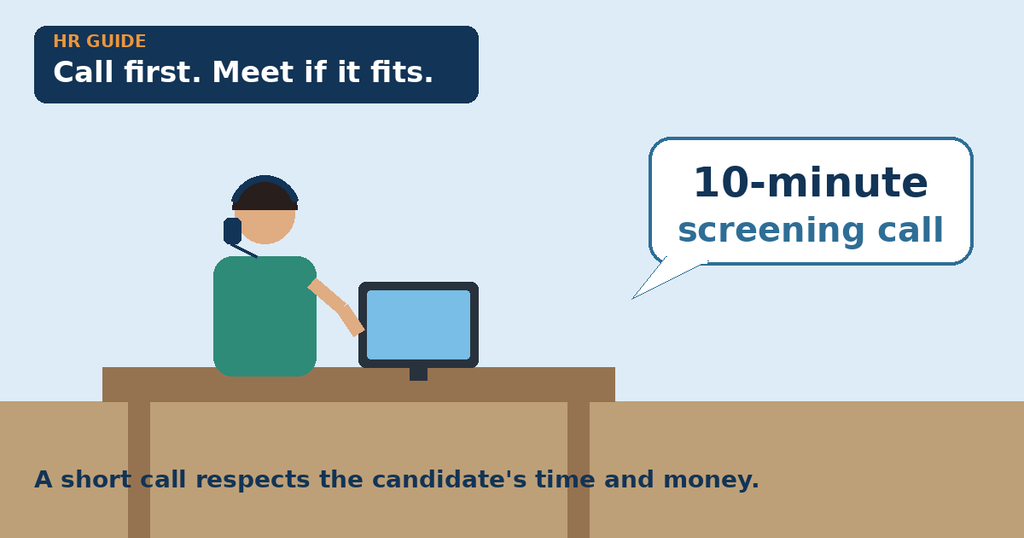
The idea at the center of the post is easy to apply:
- Start with a short phone call or online interview.
- Confirm the basics: relevant experience, skills, location, notice period and salary expectations.
- If there is a genuine match, then invite the candidate to the office.
The goal is not to avoid face-to-face meetings. It is to make sure that when someone does travel, there is a real reason for it.
What the Community Said
The comment section turned into a rich, honest conversation. Here are the voices that stood out.
The Candidates: Time, Money and Dignity
Many job seekers shared experiences that went well beyond the cost of fuel.
Shahid N., a senior HR and operations leader, agreed that virtual interviews save money, but said the reality is harsher. Candidates are often called in, kept waiting for hours, and then sent home because an interviewer was unavailable. He reminded readers that being unemployed does not make someone’s time, money or dignity matter any less.
Muhammad Hamza, a project manager, shared that over three months of interviews he repeatedly saw companies invite candidates to on-site second and final rounds without thinking about travel costs. Worse, many then went silent without any feedback. His point: the least a company can do is respect a candidate’s time, effort and money by communicating clearly.
Bhekani Shange described travelling from Durban to Pretoria for an interview, paying for a cab and an overnight bus, being shown around the company, and then never hearing back. It is a reminder that this problem is not limited to one country.
Kinzay Writer, a content writer from Chiniot, explained how travelling for a 15-minute interview is especially hard and expensive for a woman from a smaller city, and called a quick call a more respectful and practical option.
Pintu Yadav, who has travelled from a small town for interviews, said that a screening call helps recruiters find genuinely interested people. In his words, hiring should be about skills, not about who can afford to travel.
The Recruiters: A View From the Other Side
Hiring professionals added important context.
Saad Khosa, who manages operations and field-level hiring, shared that he now starts with a 10-minute screening call, which saves the candidate’s fuel and his own team’s time.
Farrah Tahir, an HR executive, offered a candid view from the recruiter’s desk. She noted that out of 200 profiles, only about 10 may be relevant, and some applicants exaggerate their skills or submit AI-written CVs without reviewing them. For this reason, she believes physical interviews still matter for judging communication and confidence. Her solution? If candidates read job descriptions carefully and presented themselves honestly, hiring would be easier for everyone.
Syed Hassan Abbas, a business coach, said he deliberately avoids calling people from other cities unless the team is almost sure about the person, and relies on calls and video conversations first. He also encouraged job seekers to understand the economic pressure many employers face.
Taraki, a company page that joined the discussion, summed up the middle ground neatly: a short call can cover salary expectations, location, notice period and experience, and candidates should be invited in only when there is a real fit, and told the outcome either way.
The Balanced Voices
Not everyone saw it in black and white, and these views make the topic stronger.
Fahad Nasir, a social media manager, pointed out that some people present themselves better in person and that seeing the office helps candidates judge the fit too. His suggestion: let candidates choose between an online screening and an in-office interview.
Naima Mukhtar noted that hiring teams use AI-written job descriptions just as candidates use AI-written CVs, so she feels a video interview should be the first step so both sides know what to expect.
Rafaqat Ali reminded everyone that poor internet connectivity can make remote interviews difficult in many areas.
A commenter named Legal Advisor offered a different angle altogether, arguing that in big cities public transport can cost far less than a cab, and that job seekers should consider the cheaper option.
Practical Advice From the Comments
Some of the most useful ideas were small and actionable:
- UnlockPrep AI suggested that when you are invited to an in-person first round, you can politely ask for a 15-minute video call first and offer two time slots. Framed as saving the recruiter’s time, it often works.
- Osama Ali, a marketing manager, recommended asking about the salary bracket before you travel and sharing your current or previous earnings so both sides can decide early.
- Abdullah Z., a packaging designer, asked hiring managers to put the role details and salary range in the job post, so candidates do not need to ask on WhatsApp first.
What Recruiters Can Do Tomorrow
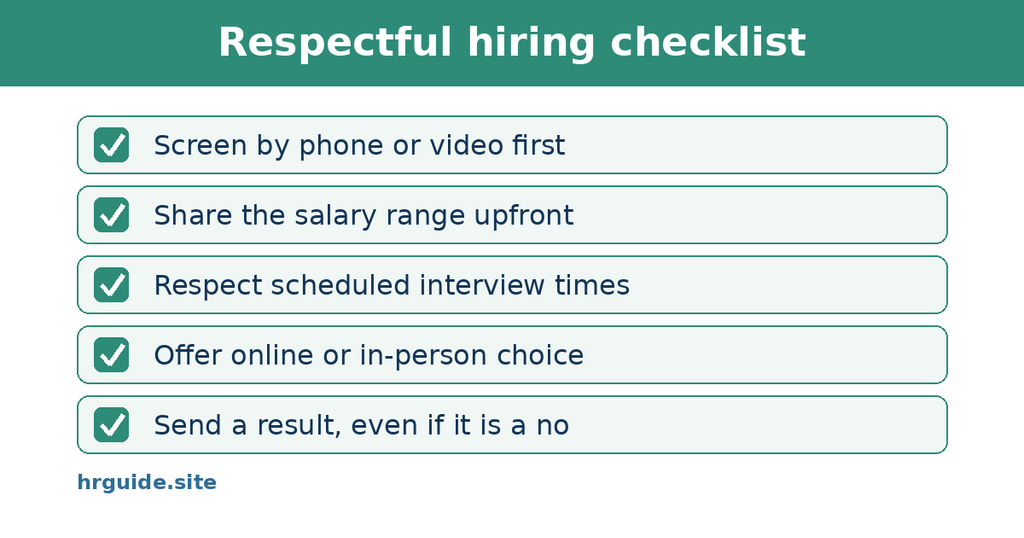
- Screen by phone or video first. Reserve office visits for shortlisted candidates.
- Share the salary range and role details upfront. It filters out mismatches on both sides.
- Respect scheduled times. If you call someone in, be ready for them.
- Offer a choice. Online or in-person, whichever the candidate prefers for the first round.
- Close the loop. Send a short message with the result, even if it is a no.
- Consider reimbursing travel for candidates you invite to later rounds.
What Job Seekers Can Do
- Read the job description carefully before applying.
- Ask for the role and salary range before committing to travel.
- Request an online first round politely, and offer time slots.
- Keep your CV honest and personal, not generic or copy-pasted.
- Choose cost-effective transport when you do need to attend.
Final Thoughts
The response to this post shows that both sides want the same thing: a hiring process that is efficient, honest and humane. Recruiters want relevant, serious candidates. Candidates want to be treated as people, not as line items. A 10-minute call can bridge a surprising amount of that gap.
Hiring should open doors, not create financial burdens.
What do you think? Should the first interview be online by default? Share your opinion in the comments below.

About Muhammad Faisal
Muhammad Faisal is an HR professional with an MBA in Human Resources and six years of experience across diverse HR domains. Through HRGuide.site, he turns real-world HR knowledge into practical insights, career advice, interview tips, and valuable resources to help professionals grow and organizations thrive.