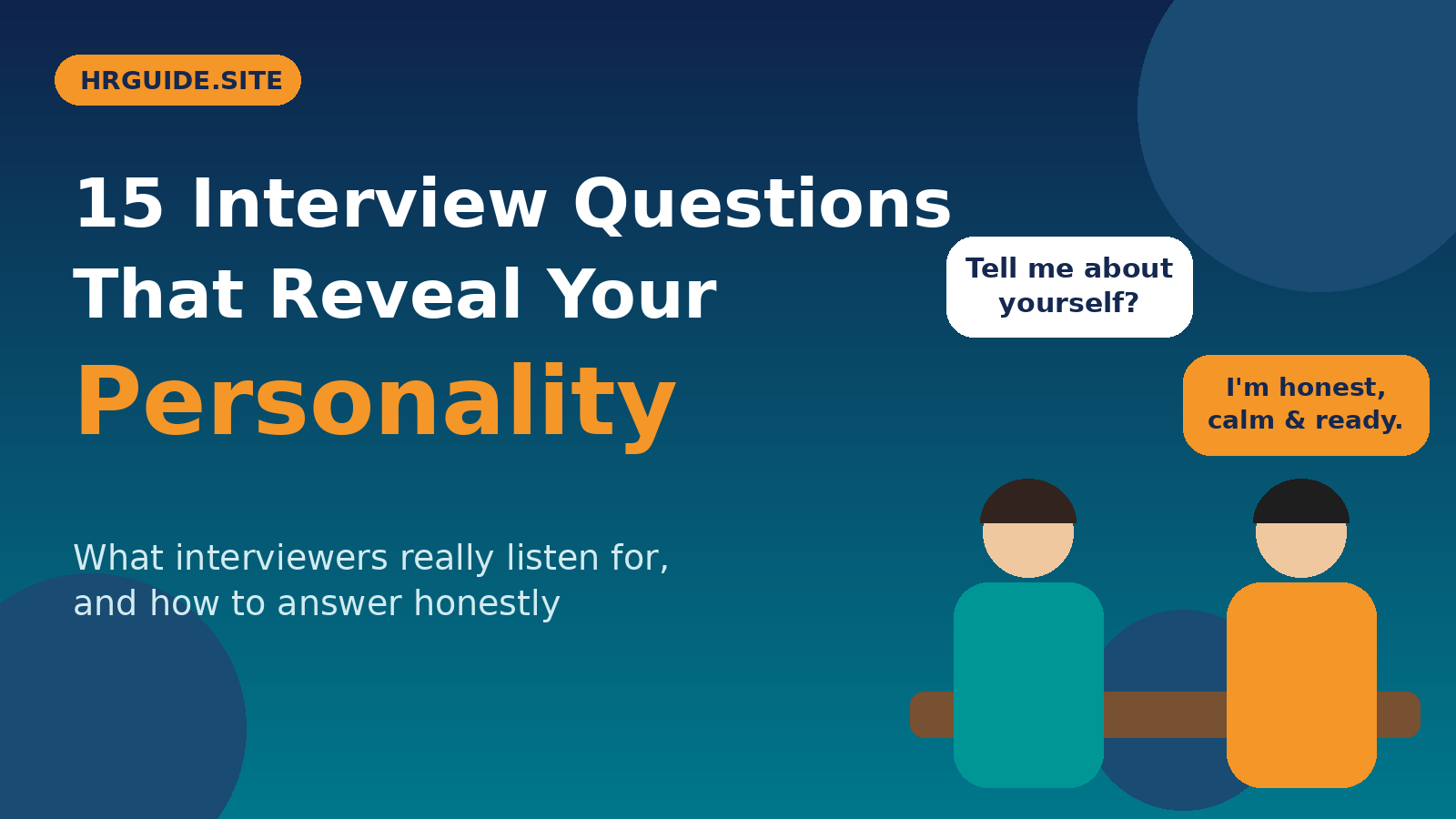
15 Interview Questions That Reveal Your Personality (With Sample Answers)
Introduction
Nobody walks into an interview thinking, “I hope they find out how I handle failure today.” But that is often exactly what is happening.
Your degree and your CV show what you have done. Your answers show who you are. A good interviewer already knows you can do the job on paper, so what they want to find out is how you think, how you react under pressure, and whether you will fit the team.
The good news is that you cannot, and should not, fake your personality. You can prepare to express it clearly and honestly. This guide covers 15 common interview questions, what each one reveals, and how to answer it step by step.
| Note Interviewers read personality signals, but no single answer defines you. A nervous answer does not make you a weak candidate. It makes you human. |
| I still remember my own first interview. My hands were cold, my voice was shaky, and I forgot the answer to a question I knew well. Looking back, the interviewer was not judging my nerves. They were watching how I recovered. That is the real test behind these questions. |
How to Use This Guide (Step by Step)
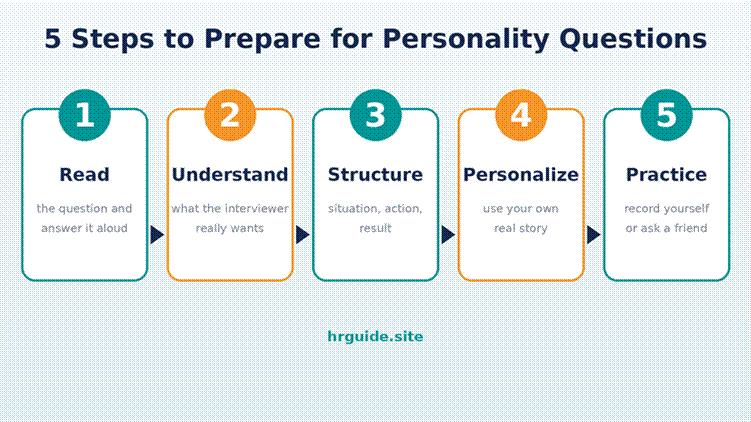
- Read each question and answer it aloud first, without looking at the tips.
- Read “What it reveals” to understand the interviewer’s real goal.
- Follow the short step-by-step method for that question.
- Replace the sample answer with your own real story. Honest stories always beat perfect scripts.
- Practice with a friend, or record yourself on your phone.
The 15 Questions
1. “Tell me about yourself.”
What it reveals: Confidence, communication style, and what you consider important.
Step by step:
- Start with your present (current role or studies).
- Add one or two past highlights.
- End with why you are excited about this role.
Sample answer:
“I’m an HR professional with six years of experience in employee relations. I started in payroll, which taught me accuracy, and moved into people management because I enjoy solving workplace problems. I’m excited about this role because it combines policy work with real impact on people.”
Avoid: Reciting your whole CV or sharing private life details.
2. “What is your greatest strength?”
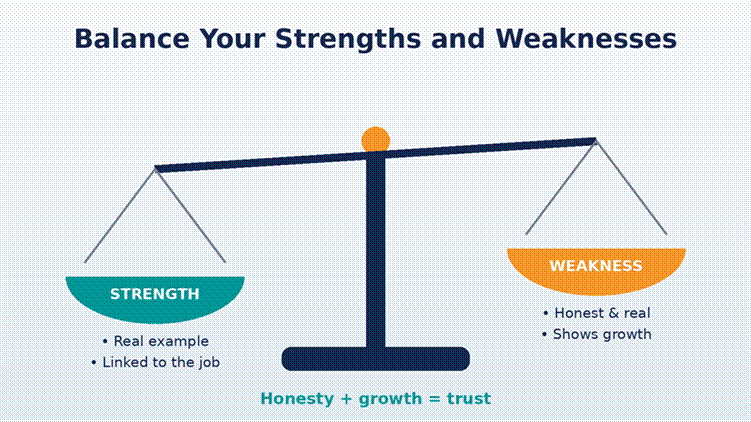
What it reveals: Self-awareness, and whether your strength matches the job.
Step by step:
- Pick one strength relevant to the role.
- Give a real example.
- Explain the result.
Sample answer:
“I stay calm under pressure. During a payroll deadline when two team members were absent, I reorganized the tasks and we finished on time with zero errors.”
Avoid: Listing five strengths with no proof.
3. “What is your greatest weakness?”
What it reveals: Honesty, humility, and willingness to grow.
Step by step:
- Name a real weakness that is not critical for the job.
- Say what you are doing to improve.
- Show your progress.
Sample answer:
“I used to hesitate to delegate because I wanted everything perfect. Now I assign tasks with clear instructions and a short check-in, and it has made my team faster.”
Avoid: Answers like “I’m a perfectionist” or “I work too hard.” Interviewers have heard them many times.
4. “Tell me about a time you failed.”
What it reveals: Accountability. Do you blame others or learn from mistakes?
Step by step:
- Describe the situation briefly.
- Take responsibility without excuses.
- Explain what you learned and how you applied it.
Sample answer:
“I once missed a compliance deadline because I assumed another department had submitted the report. Since then I confirm in writing and set reminders. We have not missed a deadline since.”
Avoid: Saying “I have never failed.”
| I once interviewed a candidate who, when asked about a failure, said the project failed because his team did not support him. He did not mention a single thing he could have done differently. The skills on his CV were strong, but that answer told me he might blame others when things went wrong. Taking responsibility, even for a small mistake, would have changed the whole impression. |
5. “How do you handle stress and pressure?”
What it reveals: Emotional control and your coping habits.
Step by step:
- Describe one real technique (prioritizing, short breaks, talking to a mentor).
- Give an example of it working.
Sample answer:
“I write down everything on my plate, rank it by urgency, and start with the top item. It turns a heavy feeling into a clear list.”
Avoid: Claiming you never feel stress.
6. “Describe a conflict with a coworker and how you resolved it.”
What it reveals: Empathy, maturity, and communication.
Step by step:
- Stay neutral when describing the situation.
- Explain how you listened to the other person.
- Share the outcome.
Sample answer:
“A colleague and I disagreed about deadlines. I asked to talk privately, listened to their workload, and we agreed on a shared schedule. We worked together better afterward.”
Avoid: Speaking badly about former coworkers or bosses. It shows how you might talk about this company later.
| As an HR professional, I have noticed that candidates often feel tempted to explain why they left their last job by criticizing the company or their boss. I once interviewed a candidate with excellent experience who spent several minutes describing how unfair his previous manager was. His complaints may have been true, but the interview changed after that. Instead of asking about his skills, I found myself wondering how he would speak about us one day. He did not get the job, and it was not because of his ability. |
7. “Why do you want to leave your current job?”
What it reveals: Attitude, loyalty, and professionalism.
Step by step:
- Focus on growth, not complaints.
- Be honest but diplomatic.
- Connect your reason to the new role.
Sample answer:
“I’ve learned a lot there, but I’ve reached the limit of growth in my current role. I’m looking for broader responsibility.”
Avoid: Criticizing your employer.
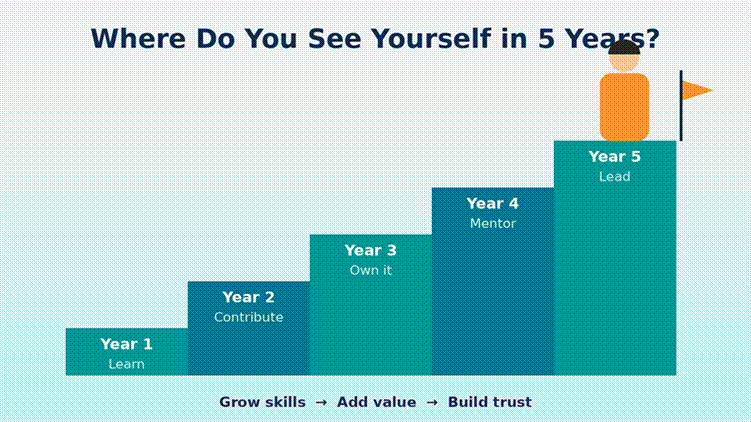
8. “Where do you see yourself in five years?”
What it reveals: Ambition, realism, and commitment.
Step by step:
- Show growth in skills and responsibility.
- Connect it to the company.
- Stay realistic.
Sample answer:
“I hope to be a trusted senior member of the team, mentoring others and contributing to larger projects.”
Avoid: Saying you want your interviewer’s job, or that you plan to leave soon.
9. “What motivates you?”
What it reveals: Your inner drive: money, learning, impact, or recognition.
Step by step:
- Be honest about what drives you.
- Give a real example.
- Connect it to the job.
Sample answer:
“I’m motivated by solving problems that help people. When an employee tells me a process became easier, it makes my day.”
Avoid: Saying only “money” with no other reason.
10. “How do you handle criticism?”
What it reveals: Ego, openness, and whether you are coachable.
Step by step:
- Show that you listen first.
- Ask questions to understand.
- Explain how you improved.
Sample answer:
“My manager once told me my reports were too long. I asked for an example of a good one, simplified my format, and the feedback improved.”
Avoid: Getting defensive or blaming the critic.
11. “Do you prefer working alone or in a team?”
What it reveals: Work style and flexibility.
Step by step:
- Say you can do both.
- Give one example of each.
Sample answer:
“I focus best alone on analysis, but I enjoy teamwork for brainstorming. In my last project I researched independently and then presented my ideas to the team.”
Avoid: Saying you cannot work with others.
12. “Tell me about a time you showed leadership.”
What it reveals: Initiative and how you treat people. Leadership does not need a title.
Step by step:
- Describe a situation where you stepped up.
- Explain what you did.
- Share the result.
Sample answer:
“When a new colleague was struggling, I created a short guide and trained them for a week. They became independent and later helped others too.”
Avoid: Taking all the credit for a team result.
13. “What would your previous manager say about you?”
What it reveals: Honesty, reputation, and how others see you.
Step by step:
- Give two positive qualities.
- Add one growth area.
- Keep it balanced and truthful.
Sample answer:
“They would say I’m dependable and good with people. They would also say I used to take on too much, which I’m learning to manage by prioritizing.”
Avoid: Exaggerating. They may call to check.
14. “What do you do when you don’t know the answer?”
What it reveals: Humility and resourcefulness.
Step by step:
- Admit it honestly.
- Explain how you would find the answer (research, ask an expert).
- Say you will follow up.
Sample answer:
“I’d be upfront that I’m not sure, check reliable sources or ask a senior colleague, and then follow up with the correct answer.”
Avoid: Bluffing. It damages trust quickly.
15. “Why should we hire you?”
What it reveals: Confidence, clarity, and how well you understand the role.
Step by step:
- Match your top two skills to their needs.
- Add one personal quality.
- Close with enthusiasm.
Sample answer:
“You need someone who can manage employee relations calmly, and I have six years of doing exactly that. I’m also dependable, and I care about doing this work well.”
Avoid: Comparing yourself badly to other candidates.
Common Mistakes to Avoid
- Memorizing answers word for word
- Exaggerating or lying about achievements
- Giving one-word answers
- Criticizing past employers
- Forgetting to smile and make eye contact
Final Tips Before the Interview
- Sleep well the night before.
- Practice for 15 minutes daily for a week.
- Prepare three real stories from your own life that you can adapt to many questions.
- Breathe slowly before you answer. A pause looks thoughtful, not weak.
- Remember, the interviewer wants you to succeed too.
Frequently Asked Questions
Can interview questions really reveal personality?
They give signals about communication, attitude, and values, but they are not a scientific test. Good interviewers use them as one part of the whole picture.
Should I answer with the truth even if it is not perfect?
Yes. Honest answers with a growth message build more trust than polished but false ones.
How long should my answers be?
Aim for one to two minutes: long enough for an example, short enough to keep attention.
What if I get nervous and forget my answer?
Pause, take a breath, and say, “Let me think for a moment.” It is perfectly acceptable.
Are these questions used worldwide?
Yes. The wording may change by country and industry, but the core intent is the same everywhere.
Conclusion
Interview questions are less about tricking you and more about getting to know you. The next time someone asks, “Tell me about yourself,” remember they are not checking a script. They are looking for a real person they can work with.
Prepare your stories, stay honest, and let your personality come through. The right job will want the real you.
| As an HR professional, I always hire the person who is real over the person who is rehearsed. If you stay honest and prepared, the right job will find you. Which of these 15 questions do you find hardest? Tell me in the comments.” |

About Muhammad Faisal
Muhammad Faisal is an HR professional with an MBA in Human Resources and six years of experience across diverse HR domains. Through HRGuide.site, he turns real-world HR knowledge into practical insights, career advice, interview tips, and valuable resources to help professionals grow and organizations thrive.