25 Most Common Job Interview Questions and Best Answers (With Samples)
Prepare with the 25 most common job interview questions, why interviewers ask them, and word-for-word sample answers you can personalise. Free step-by-step guide.
Last updated: November 2026 | Reading time: about 14 minutes | By Muhammad Faisal
Your hands are cold. You have read the job post five times. You have practised in the mirror, and still one thought keeps coming back: “What if they ask something I cannot answer?”
Every candidate feels this. The good news is that interviewers are far more predictable than you think. Across companies, industries and countries, they ask the same 25 or so questions in different words. If you prepare these properly, you walk in with calm confidence instead of fear.
In this guide you will find the 25 most common job interview questions, why the interviewer is asking each one, and a best-answer sample you can copy the structure of. Please do not memorise the samples word for word. Replace the [brackets] with your own real facts, because honest answers always sound stronger than perfect ones.
How to Use This Guide
- Read each question and the “why they ask” line first. Understanding the hidden purpose is half the answer.
- Read the sample, then write your own version in the yellow experience boxes or in a notebook.
- Say your answers out loud. Speaking is a different skill from thinking.
- Keep each answer between 45 and 90 seconds.
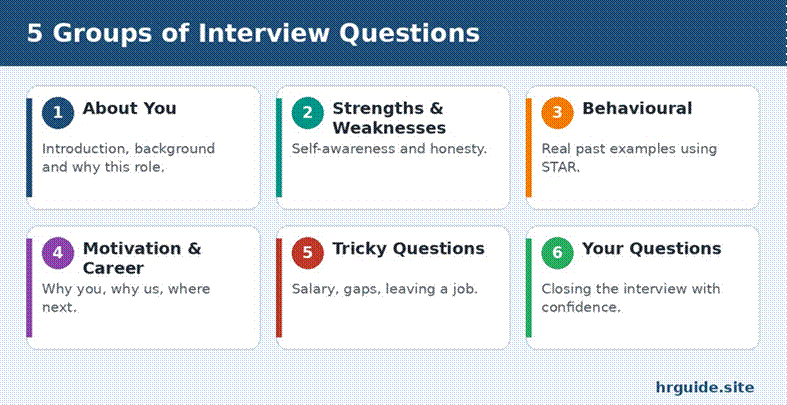
Group 1: Questions About You
These come first in almost every interview. They set the mood, so a clear and confident start matters a lot.
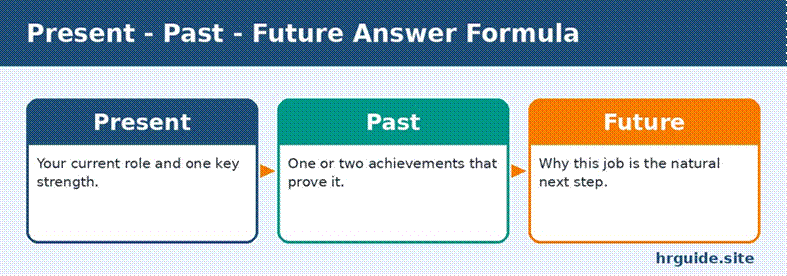
Use the Present, Past, Future formula for “Tell me about yourself”
1. Tell me about yourself.
Why they ask: They want a short professional story, not your life history. They also check how clearly you communicate.
| BEST ANSWER (SAMPLE) “I am a [job title] with [X] years of experience in [field]. Right now I handle [main responsibility], and recently I [achievement with a number]. Before that I built a strong base in [skill or area]. I am now looking for a role like this one, where I can use [strength] to help your team [goal].” |
2. Why did you apply for this job?
Why they ask: They want to know whether you chose this role on purpose or are simply applying everywhere.
| BEST ANSWER (SAMPLE) “Three things attracted me: the role matches my experience in [skill], your company is known for [specific thing you researched], and the job offers growth in [area] that I am ready for. I can see myself contributing from the first month.” |
3. What do you know about our company?
Why they ask: They test your effort. Candidates who research stand out immediately.
| BEST ANSWER (SAMPLE) “I know you [what the company does], you serve [customers or market], and recently I read that [news, project or value]. What impressed me most is [one specific detail], because it matches how I like to work.” |
4. Why should we hire you?
Why they ask: This is your sales pitch. They compare you with other candidates.
| BEST ANSWER (SAMPLE) “You need someone who can [main need of the job]. In my last role I [result with a number], and I learn quickly. I also bring [extra strength], so I can start adding value without long training.” |
5. Walk me through your CV.
Why they ask: They check that your story is logical and that you can explain your own career choices.
| BEST ANSWER (SAMPLE) “I started as [first role], where I learned [skill]. I then moved to [second role] because I wanted [reason]. In my current role I [responsibility and result]. Each step prepared me for the responsibilities in this position.” |
When I started my HR career, I noticed how many candidates were applying for jobs but receiving no response. Some had good qualifications but weak CVs, while others struggled to explain their experience during interviews. I realized that finding a job is not just about having a degree or experience—it also requires the right strategy, preparation, and communication. Over the years, I have reviewed CVs, conducted hundreds of interviews, and guided candidates through their job search. I have seen how small mistakes can cost someone a great opportunity. This article is based on real hiring experience and the common mistakes I have observed in candidates, along with practical ways to improve. |
Group 2: Strengths, Weaknesses and Personality
6. What are your greatest strengths?
Why they ask: They want strengths that match the job, supported by proof.
| BEST ANSWER (SAMPLE) “My biggest strength is [skill]. For example, when [situation], I [action] and the result was [result]. I also keep improving it by [habit].” |
7. What is your biggest weakness?
Why they ask: They look for self-awareness and honesty, not perfection.
| BEST ANSWER (SAMPLE) “I used to take on too much myself instead of delegating. I noticed it slowed the team, so now I plan tasks every Monday and share work clearly. It has improved my deadlines, and I am still working on it.” |
| TIP Never say “I have no weakness” or give a fake weakness like “I work too hard”. Choose a real, small weakness and show the steps you are taking to fix it. |
8. How do you handle pressure or stress?
Why they ask: They want to see how you behave when work gets difficult.
| BEST ANSWER (SAMPLE) “I break the work into priorities, speak early if I need help, and take short breaks to stay clear-headed. During [busy period] I handled [workload] by making a daily checklist, and we met every deadline.” |
9. How would your colleagues describe you?
Why they ask: They compare your self-image with what your references will say.
| BEST ANSWER (SAMPLE) “I think they would say I am dependable and calm. A colleague once told me that I am the person who always follows through, and I am proud of that.” |
10. What motivates you?
Why they ask: They want to know whether your motivation fits the job and the culture.
| BEST ANSWER (SAMPLE) “I am motivated by solving real problems and seeing the results. Knowing that my work helps [people or team] makes even difficult days meaningful, and learning new skills keeps me energised.” |
Group 3: Behavioural Questions
These begin with “Tell me about a time when…”. The interviewer wants real proof from your past. The best tool is the STAR method.
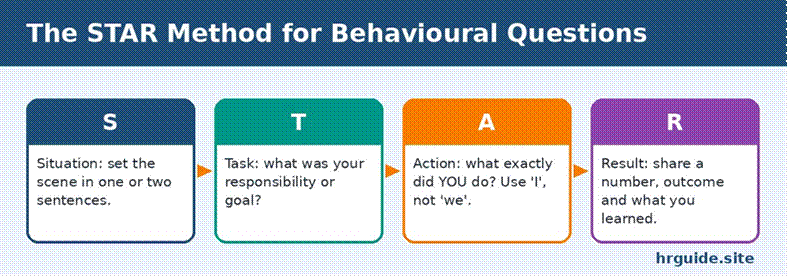
11. Describe a time you faced a difficult challenge.
Why they ask: They check your problem-solving and attitude under difficulty.
| BEST ANSWER (SAMPLE) “Situation: our team lost two members during a busy month. Task: I had to keep [process] running. Action: I created a priority list, shared the work and updated the manager daily. Result: we finished on time and I learned how to plan for sudden changes.” |
12. Tell me about a time you made a mistake.
Why they ask: They want honesty and learning, not a flawless record.
| BEST ANSWER (SAMPLE) “Once I sent a report with a wrong figure. I told my manager immediately, corrected it within an hour and added a second check to my process. Since then I have not repeated that error.” |
13. Tell me about a conflict with a colleague or manager.
Why they ask: They test emotional maturity and how you protect relationships.
| BEST ANSWER (SAMPLE) “A colleague and I disagreed about how to prioritise tasks. I asked for a private talk, listened to his view and we agreed on a shared schedule. The project succeeded and we still work well together.” |
| COMMON MISTAKE Do not blame or insult your old manager or colleagues. Even if you were right, speaking badly about others makes interviewers worry about how you will speak about them. |
14. Describe a time you worked in a team to achieve a goal.
Why they ask: They want a team player who also takes ownership.
| BEST ANSWER (SAMPLE) “On a [project], I was responsible for [part]. I coordinated with [teams], shared updates every week and helped a teammate who was behind. We delivered [result], and our manager recognised the team.” |
15. Tell me about a time you met a tight deadline.
Why they ask: They check planning, focus and communication.
| BEST ANSWER (SAMPLE) “I once had two days to complete a task normally done in a week. I listed the must-do items, asked for one extra person and checked progress every few hours. We submitted on time and the quality stayed high.” |
| MY STAR STORIES: 1. A Challenge: In my first factory job, I was given 47 workers with no proper record. Attendance was in a register, salary in a separate copy. I created one Excel master file for all workers, linked attendance with payroll, and in 2 weeks the salary errors went from 9 to zero. 2. A Mistake: In my second year as an HR officer, I made a payroll error that affected 12 employees. I had entered overtime wrong. It was painful, but I told my manager the same day and fixed it before payday. That day I learned honesty protects trust more than hiding a mistake. 3. A Conflict: Once a line manager wanted to terminate a worker without any warning letter. I stopped the process, showed him the labour law and our policy, and gave the worker a proper written warning instead. We saved the company from a legal case and the worker improved his performance in 30 days. 4. A Deadline: We had to hire 25 workers in 10 days for a new production line. I posted the jobs, screened 180 CVs in 3 days, and completed interviews and medicals on time. We started production on the 11th day with a full team and zero delay. |
Group 4: Motivation and Career Direction
16. Where do you see yourself in five years?
Why they ask: They want to know whether your plans fit the company and whether you will stay.
| BEST ANSWER (SAMPLE) “In five years I want to be a stronger expert in [field] and ready to take on more responsibility, perhaps leading a small team. I hope to grow that path here with your company.” |
17. Why are you leaving your current job?
Why they ask: They watch for red flags, negativity and instability.
| BEST ANSWER (SAMPLE) “I have learned a lot in my current role, but I am ready for more responsibility and a bigger challenge. This position offers exactly that, so it is a step forward, not an escape.” |
18. Why is there a gap in your CV?
Why they ask: They want a calm, honest and short explanation.
| BEST ANSWER (SAMPLE) “I took time for [reason: study, family, health, relocation], and during that time I also [course, freelance, volunteering]. I am now fully ready and excited to return to work.” |
19. What kind of work environment do you prefer?
Why they ask: They check culture fit.
| BEST ANSWER (SAMPLE) “I enjoy a respectful and goal-focused environment where people share feedback openly. I work well both independently and with a team, and I like clear communication.” |
20. How do you keep learning and stay updated?
Why they ask: They want someone who grows without being pushed.
| BEST ANSWER (SAMPLE) “I follow [industry websites or LinkedIn creators], take short online courses, and discuss new ideas with colleagues. Recently I completed [course or skill], which helped me [result].” |
Group 5: Tricky and Closing Questions
21. What are your salary expectations?
Why they ask: They check whether your expectation fits their budget.
| BEST ANSWER (SAMPLE) “Based on my research for this role and my [X] years of experience, I expect a range of [amount] to [amount]. I am flexible and open to discussing the full package.” |
| TIP Research the salary range before the interview and give a range, not a single number. If you feel unsure, ask politely: “Could you share the budget for this position?” |
22. Are you interviewing with other companies?
Why they ask: They want to know how serious you are and how fast they must decide.
| BEST ANSWER (SAMPLE) “Yes, I am speaking with a few companies, but this role is a top choice because [honest reason].” |
23. How soon can you join?
Why they ask: They plan hiring dates.
| BEST ANSWER (SAMPLE) “I have a [30-day] notice period and I will make sure I hand over my work properly. If needed, I can discuss an earlier date with my current employer.” |
24. How do you handle feedback or criticism?
Why they ask: They want a learner, not someone defensive.
| BEST ANSWER (SAMPLE) “I welcome it. I listen fully, ask for an example and then make a plan to improve. Honest feedback has helped me grow faster than any course.” |
25. Do you have any questions for us?
Why they ask: This is your last chance to show interest. Saying “no” looks careless.
| BEST ANSWER (SAMPLE) “Yes, thank you. What does success look like in this role in the first 90 days? And what is the best part of working in this team?” |
Interview Questions for Freshers (No Work Experience)
No experience does not mean no value. Interviewers know a fresh graduate has no long career to talk about. They are checking attitude, learning speed and basic skills. Use your studies, projects, internships, volunteering and part-time work as your proof.
1. Tell me about yourself (fresher version)
Why they ask: They want to see who you are and how clearly you can speak, even without a work history.
Best answer (sample): “I recently completed my [degree] in [subject] from [university]. During my studies I worked on [project or assignment], where I learned [skill]. I also [internship, society role or volunteering]. I am now looking for my first role in [field], where I can learn quickly and contribute with my [strength].”
2. You have no experience. Why should we hire you?
Why they ask: They want to see whether you are confident without being arrogant.
Best answer (sample): “I understand I am new to the workplace, but I learn quickly and I take responsibility. In my [project or internship] I [specific action and result]. I am ready to start from the basics, follow instructions and grow with your team.”
3. What did you learn from your studies or projects that helps in this job?
Why they ask: They want to connect your education to real work.
Best answer (sample): “In my [subject], I studied [relevant topic] and completed a [project] where I [what you did]. This taught me [skill], which I can use in this role for [task].”
4. Why did you choose this field?
Why they ask: They want to know whether your interest is genuine or whether you are applying to anything.
Best answer (sample): “I became interested in [field] when [honest reason, such as a course, a person or an experience]. Since then I have [action: course, reading, project]. I want to build my career here because [reason].”
5. What is your biggest achievement so far?
Why they ask: They look for effort, results and how you describe success.
Best answer (sample): “My biggest achievement was [result], for example [finishing a final-year project, leading a society event, or achieving a high grade]. It was difficult because [challenge], but I [action] and finished with [result].”
Tip for freshers: Add one honest line about learning: “I know I still have a lot to learn, and I am ready to take feedback.” Interviewers value this more than pretending to know everything.
From my HR desk: From my HR desk: I often interview fresh graduates who have potential and good qualifications, but struggle to communicate their skills confidently. Sometimes, the difference between rejection and selection is not experience—it’s preparation, confidence, and how you present yourself.
Smart Questions You Can Ask
- What are the biggest challenges for this role right now?
- How is performance measured here?
- What learning and growth opportunities are available?
- What are the next steps in the hiring process?
| MY INTERVIEW DAY STORY: My first HR interview was for a textile mill job in Lahore. My hands were shaking, my CV was only one page, and I had no real experience. The manager asked me a question that surprised me: “If a worker comes to you crying about his salary, what will you do?” I took a slow breath, smiled and said, “May I take a moment to think?” That pause saved the whole interview. Then I said, “First I will listen to him completely, check his attendance and salary sheet in front of him, and if there is a mistake, I will fix it the same day.” He smiled and said, “You are hired.” That day I learned, in HR, listening is more important than speaking. If I could tell my younger self one thing before that first interview, I would say: Don’t try to sound perfect. Be honest, be calm, and be human. |
Interview Do’s and Don’ts
| Do | Don’t |
| Arrive 10 to 15 minutes early | Arrive late or unprepared |
| Research the company and the role | Say “I don’t know anything about you” |
| Give examples with numbers | Give long, vague answers |
| Be honest and positive | Criticise your old employer |
| Send a thank-you message the same day | Ask only about salary and holidays |
Final Interview Checklist
- Print 2 copies of your CV and carry a notebook.
- Prepare 5 stories using the STAR method.
- Practise “Tell me about yourself” until it takes 60 seconds.
- Prepare 3 questions to ask the interviewer.
- Choose clean, simple clothes the night before.
- Sleep well. A rested mind answers better than a memorised one.
Frequently Asked Questions
How long should my answers be?
Most answers should take 45 to 90 seconds. Short enough to hold attention, long enough to give proof.
What if I forget my answer during the interview?
Pause, take a breath and say, “Let me think for a moment.” Interviewers respect calm thinking more than rushed words.
Is it okay to bring notes?
Yes, a small notebook with your questions is fine and shows preparation. Do not read your answers from it.
Final Words
An interview is not a test of whether you are perfect. It is a conversation about whether you and the company are right for each other. Prepare well, speak honestly and remember: a rejection is not the end, it is information. Every interview makes you better for the next one.
If this guide helped you, share it with a friend who is job hunting. Good luck. You are more ready than you think.
Disclaimer:
This article is for general education and information. Hiring practices, labour laws and company policies differ by country and employer, so adapt the advice to your situation and check local rules where needed. Sample answers and templates are examples; please personalise them with your own facts.

About Muhammad Faisal
Muhammad Faisal is an HR professional with an MBA in Human Resources and six years of experience across diverse HR domains. Through HRGuide.site, he turns real-world HR knowledge into practical insights, career advice, interview tips, and valuable resources to help professionals grow and organizations thrive.