
10 Reasons Why You Are Not Getting a Job (And How to Fix Each One)
Sending applications but getting no interviews? Discover the 10 real reasons you are not getting a job and the simple fixes that work. Free step-by-step guide.
Last updated: November 2026 | Reading time: about 12 minutes | By Muhammad Faisal
You open your email every morning. Nothing. You apply, you wait, you refresh. Weeks pass, and slowly a painful thought starts to grow: “Maybe something is wrong with me.”
Let me say this clearly: nothing is wrong with you. In most cases, the problem is not your worth, it is a few fixable mistakes in how you search for work. Recruiters often spend only 6 to 10 seconds on a first CV scan, and a company may receive hundreds of applications for one post. Small details decide who gets a call.
In this guide you will see the 10 most common reasons candidates are not getting hired, how to recognise each one in yourself, and exactly how to fix it, starting today.
Quick Self-Check
Tick the statements that are true for you. The more ticks you have, the more you will benefit from this article.
- I use one CV for every job.
- I apply to jobs without reading the full job post.
- I rarely hear back after applying.
- I get interviews but no offers.
- I only apply on job websites and never message people.
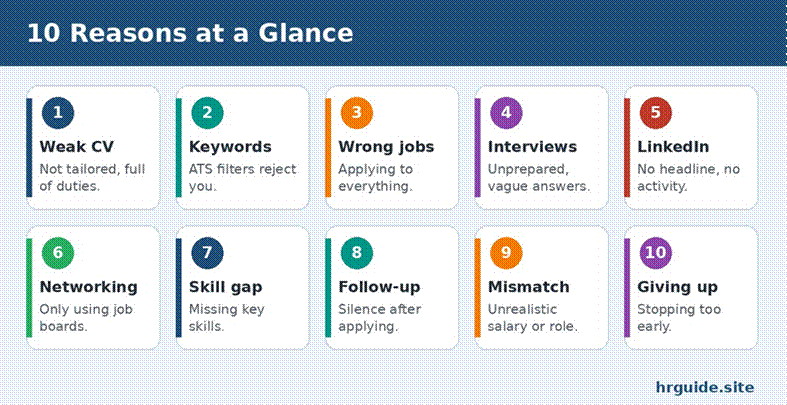
Reason 1: Your CV Is Weak or Not Tailored
Why it hurts: A CV that lists only daily duties tells the recruiter what you were given, not what you achieved. A generic CV also feels like a mass mailing.
How to know it is you: You get very few responses even though you meet the requirements.
How to fix it:
- Rewrite every bullet to show a result: “Reduced hiring time by 30%” is stronger than “Responsible for hiring”.
- Keep the CV to one or two pages with clean headings.
- Change your summary and top skills for each job post.
- Proofread twice. One spelling mistake in your title or heading can lose the call.
Reason 2: Your CV Does Not Pass the ATS (Applicant Tracking System)
Why it hurts: Many companies use software that filters CVs by keywords before a human sees them. If your CV lacks the words in the job post, it may be rejected automatically.
How to know it is you: You apply to jobs that match you well and never hear anything.
How to fix it:
- Copy important skills and job titles from the job post into your CV, but only if they are true.
- Use a simple single-column layout with standard headings: Summary, Experience, Education, Skills.
- Avoid photos, tables, text boxes and graphics.
- Save as DOCX or a text-based PDF.
Reason 3: You Apply to the Wrong Jobs
Why it hurts: Applying to every vacancy looks desperate to a recruiter and reduces your success rate. A “perfect for everything” candidate is not remembered.
How to know it is you: Your applications are spread over many different roles and levels.
How to fix it:
- Choose one or two target job titles.
- Apply when you match at least 60 to 70% of the requirements.
- Spend your time on 10 strong applications instead of 100 weak ones.
| My Experience in Recruitment and Job Applications I have reviewed hundreds of CVs and conducted over 1,000 interviews. I noticed that candidates who tailor their CVs to each job and prepare clear, relevant answers have better chances of getting shortlisted. My experience in recruitment has taught me that quality applications matter more than sending hundreds of generic CVs. |
Reason 4: You Are Not Ready for Interviews
Why it hurts: Many candidates reach the interview but lose it through vague answers, nervousness or lack of research about the company.
How to know it is you: You get interviews but rarely a second round or an offer.
How to fix it:
- Practise the 25 most common interview questions out loud.
- Prepare 5 achievement stories using the STAR method.
- Research the company, its products and recent news before every interview.
- Ask for feedback after a rejection. Even one sentence helps.
| TIP Record yourself answering “Tell me about yourself” on your phone. Watching it once feels uncomfortable and improves your delivery quickly. |
Reason 5: Your LinkedIn Profile Is Weak
Why it hurts: Recruiters search and check LinkedIn before calling. An empty profile, no photo or an unclear headline creates doubt.
How to know it is you: You have fewer than 100 connections, no summary, or you never post or comment.
How to fix it:
- Add a clear photo, a headline with your job title and key skills, and a short summary.
- List achievements with numbers under each job.
- Comment on posts in your field weekly. Visibility creates opportunities.
- Turn on “Open to Work” for recruiters only if you prefer privacy.
Reason 6: You Depend Only on Job Websites
Why it hurts: A large share of jobs are filled through referrals, direct messages and recommendations before they are ever posted publicly.
How to know it is you: Every application you send goes through a website and you know no one inside the companies.
How to fix it:
- Message HR professionals and managers politely and briefly.
- Tell friends, ex-colleagues and teachers what role you are searching for.
- Join professional groups and attend meetups or webinars.
- Ask for advice, not a job. People love helping when they feel respected.
Reason 7: You Have a Skills Gap
Why it hurts: Job requirements change fast. A candidate who has not updated tools or skills in years may lose to someone who has.
How to know it is you: The same skill appears again and again in job posts and you do not have it.
How to fix it:
- List the top 5 skills repeated in your target job posts.
- Learn one skill at a time through free or low-cost courses.
- Show proof: a small project, certificate or volunteer work.
- Add the new skill to your CV and LinkedIn immediately.
| My Professional Skill Development Journey During my HR career, I realised that continuous learning is essential for professional growth. I improved my recruitment, Excel, communication, and HR management skills through practical experience, online learning, and professional development. Applying these skills in real workplace situations helped me become more confident and effective in my career. |
Reason 8: You Do Not Follow Up
Why it hurts: A single application can disappear in a busy inbox. Silence does not always mean rejection.
How to know it is you: You apply and then wait for weeks without sending a message.
How to fix it:
- Wait 5 to 7 days, then send a short, polite follow-up email.
- Say you are still very interested and attach your CV again.
- After an interview, send a thank-you message within 24 hours.
| SAMPLE FOLLOW-UP EMAIL Subject: Following up on [Job Title] application Dear [Name], I applied for the [Job Title] position on [date] and remain very interested. My experience in [skill] matches your needs, and I would be glad to discuss how I can contribute. Thank you for your time. Kind regards, [Your Name], [Phone] |
Reason 9: Your Expectations Are Not Realistic
Why it hurts: Asking for a much higher salary or title than your experience supports, or refusing every location or schedule, removes you from the shortlist.
How to know it is you: You often reach the final step and then the discussion ends at salary or role.
How to fix it:
- Research real salary ranges for your role, city and experience level.
- Be flexible on one or two things, such as start date or title.
- Consider a first step that gets you inside the industry, then grow from there.
Reason 10: You Give Up Too Early (or Search Without a System)
Why it hurts: Job searching is a numbers and learning game. Many candidates stop right before the results start, or never track what works.
How to know it is you: You apply in bursts, forget where you applied and do not review the results.
How to fix it:
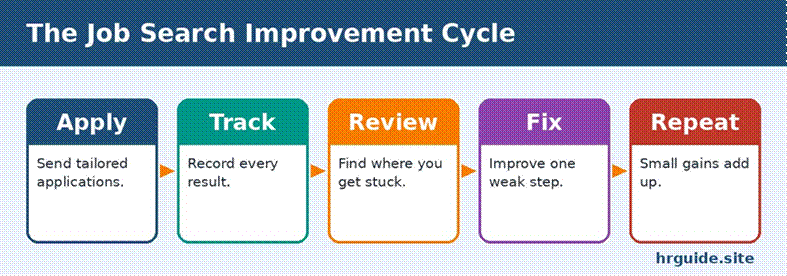
- Set a weekly target, for example 8 quality applications and 5 networking messages.
- Track every application in a simple table (see below).
- Review every Sunday: what worked, what did not, what will I change?
Free Job Search Tracker (Copy This Table)
| Company | Job Title | Date Applied | Source | Status | Follow-up Date |
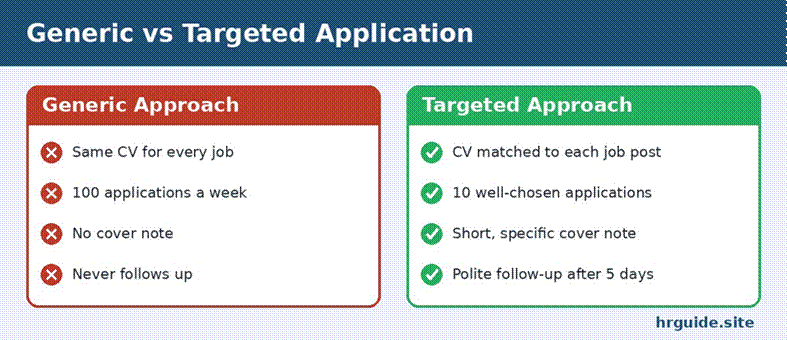
A generic application versus a targeted one
Your 7-Day Action Plan
| Day | Task |
| Day 1 | Rewrite your CV summary and top five achievements with numbers. |
| Day 2 | Update LinkedIn headline, photo and summary. |
| Day 3 | Pick two target job titles and find 10 matching vacancies. |
| Day 4 | Customise your CV and apply to 3 jobs carefully. |
| Day 5 | Message 5 professionals politely and ask for advice. |
| Day 6 | Practise 10 interview questions out loud. |
| Day 7 | Review results, update your tracker and rest. |
Frequently Asked Questions
How many applications should I send before I get a job?
There is no fixed number. A well-matched CV may need 10 to 30 applications, while a weak one may need hundreds. Quality matters more than quantity.
Is it normal to be rejected many times?
Yes. Even strong professionals face many rejections. Each one is feedback you can use to improve your approach.
Should I accept any job just to get started?
If you need income, a related first job is a good bridge. Keep learning and applying for your target role while you work.
| Job rejection is never easy, but it should not define your abilities or future. Throughout my HR career, I have seen many talented candidates face repeated rejections. My advice is to keep improving your skills, updating your CV, and preparing for interviews. Every rejection is an opportunity to learn. Stay consistent, because the right opportunity may be closer than you think. |
Final Words
Not getting a job is painful, but it is not permanent and it is not a verdict on your value. Fix one reason at a time, track your progress and stay patient with yourself. Your next application could be the one. Keep going.
Disclaimer: This article is for general education and information. Hiring practices, labour laws and company policies differ by country and employer, so adapt the advice to your situation and check local rules where needed. Sample answers and templates are examples; please personalise them with your own facts.

About Muhammad Faisal
Muhammad Faisal is an HR professional with an MBA in Human Resources and six years of experience across diverse HR domains. Through HRGuide.site, he turns real-world HR knowledge into practical insights, career advice, interview tips, and valuable resources to help professionals grow and organizations thrive.



One Comment