Employee Warning Letter Template: How to Write One
A practical guide for HR professionals, managers and business owners, with free samples
Few tasks in HR feel as uncomfortable as issuing a warning. You want to be fair. You want the employee to improve. You also want to protect the company if things go wrong later. A well-written warning letter helps with all three.
A good warning letter is not an act of punishment. It is a clear, calm, written record that says what happened, what is expected, and what will follow if nothing changes. When written properly, it gives the employee a real chance to correct course, and gives your organisation proof that the process was fair.
In this guide you will learn what a warning letter is, when to use one, what to include, how to deliver it, and the mistakes to avoid. A separate file with ready-to-use templates accompanies this article.
In this article
- What an employee warning letter is
- When you should issue one
- The progressive discipline ladder
- What every warning letter must include
- A step-by-step process
- A sample warning letter
- How to deliver it professionally
- Common mistakes to avoid
- FAQs
| During my HR career, I have learned that a poorly communicated warning can create misunderstandings between employees and management. In one situation, an employee needed formal guidance about repeated attendance issues. Instead of simply blaming the employee, I believe HR should clearly document the issue, explain the expected improvement, and give the employee an opportunity to respond. Issuing a warning is never an easy responsibility because it can affect someone’s confidence and career. I always believe in being respectful but firm. A warning should not be about embarrassing or punishing someone; it should be about correcting behaviour, maintaining fairness, and helping employees understand their responsibilities. |
What Is an Employee Warning Letter?
An employee warning letter is a formal written notice that tells an employee their conduct, attendance or performance has not met the company’s expectations. It records the issue, explains the standard that was missed, sets out what must change and by when, and states what may happen if the problem continues.
It is a communication tool first and a legal record second. The purpose is to correct behaviour, not to humiliate anyone.
When Should You Issue a Warning Letter?
Warning letters are normally used when an informal conversation has not worked, or when the issue is serious enough to deserve a written record. Typical reasons include:
- Repeated late arrival or unexplained absence
- Poor or declining work performance after support and coaching
- Breaking company policies, such as safety rules or the code of conduct
- Disrespectful or inappropriate behaviour towards colleagues or customers
- Misuse of company property, time or information
- Failure to follow reasonable instructions
Very serious matters such as theft, violence, harassment or fraud usually go through a formal inquiry rather than a simple warning, and may lead to suspension or dismissal after due process.
The Progressive Discipline Ladder
Most organisations follow a step-by-step approach, so employees know exactly what happens when problems repeat.
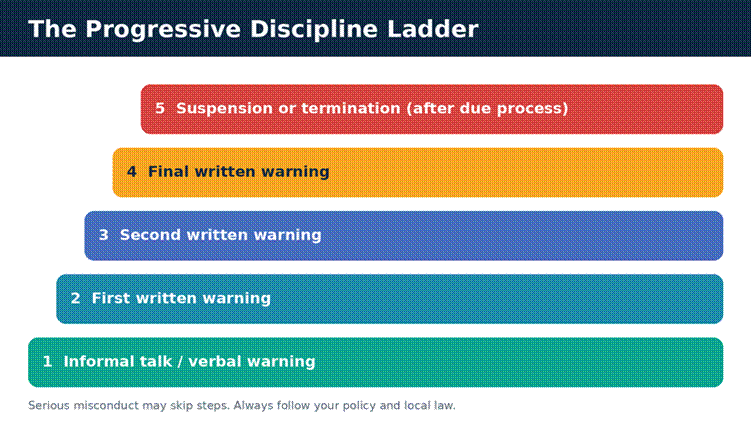
- Step 1, verbal warning: A private conversation, noted in writing by the manager, for first or minor issues.
- Step 2, first written warning: A formal letter if the issue continues or is more serious.
- Step 3, second written warning: Used when the employee has not improved after the first letter.
- Step 4, final written warning: The last notice, clearly stating that further problems may lead to dismissal.
- Step 5, suspension or termination: Only after due process, a fair hearing and a review of the full record.
Your own policy and local labour law decide which steps are required. Some countries and workplaces demand a formal inquiry, a notice period or a right to appeal before a final decision.
| In my HR practice, I believe discipline should follow a fair and documented process. We first discuss the issue with the employee, then issue a written warning if the behaviour continues, with HR and management involved in the process. I believe warnings should clearly explain the problem and expected improvement. I have learned that giving employees an opportunity to explain their situation and improve often leads to better results than making a quick decision. Patience, proper documentation, and consistent communication are essential for effective employee discipline. |
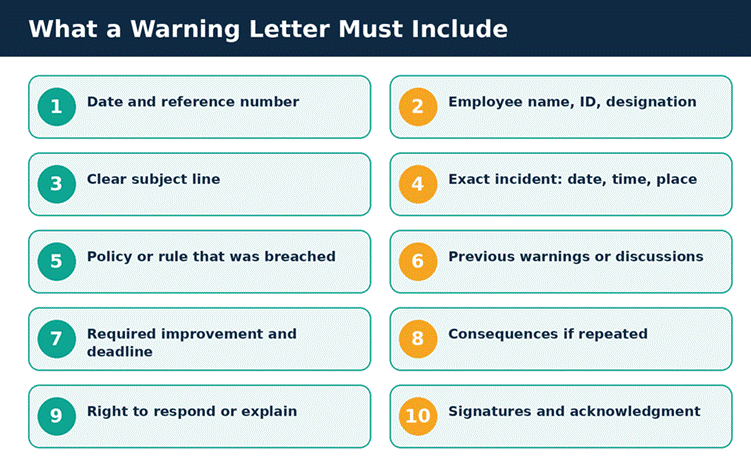
What Every Warning Letter Must Include
| Element | Why it matters |
| Date and reference number | Creates a clear record and makes the letter easy to file |
| Employee details | Name, employee ID, designation and department avoid confusion |
| Subject line | Shows the type of warning immediately, such as First Written Warning |
| Description of the incident | Facts only: what happened, when and where. No opinions or labels |
| Policy breached | Links the issue to a written rule or expectation the employee knew |
| Previous discussions | Shows that earlier conversations or warnings took place |
| Expected improvement | States exactly what must change, and by what date |
| Consequences | Explains what may happen if the problem repeats |
| Right to respond | Gives the employee the chance to explain or disagree |
| Signatures | Manager and HR sign, and the employee acknowledges receipt |
Step-by-Step: How to Write and Issue a Warning Letter
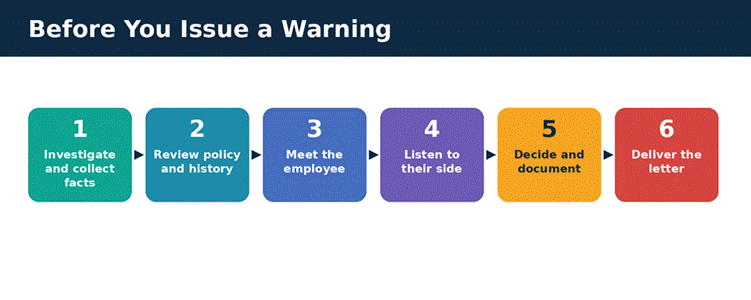
Step 1: Collect the facts
Gather attendance records, emails, reports, witness statements or system logs. Never write a warning based on rumours or one person’s opinion.
Step 2: Check the policy and the employee’s history
Confirm that a written rule exists and that the employee knew about it. Look at previous conversations, warnings, appraisals and any personal circumstances.
Step 3: Meet the employee first
Hold a private conversation. Explain the concern, show the facts, and listen carefully. Sometimes there is a valid reason, such as illness or a family emergency, and a warning may not be the right response.
Step 4: Decide the right level
Match the response to the seriousness and the history. Treat similar cases in the same way, because inconsistent discipline is a common source of unfair-treatment complaints.
Step 5: Write the letter
Use simple, neutral and factual language. Stay professional, avoid anger and sarcasm, and focus on behaviour, not personality.
Step 6: Deliver it with respect
Hand it over in a private meeting, ideally with HR present. Give the employee time to read it, ask questions and sign to confirm receipt. Signing means received, not necessarily agreed.
Sample Warning Letter (Short Version)
[Company Letterhead]
Date: [DD/MM/YYYY] Ref: [HR/WL/001]
To: [Employee Name], [Designation], [Employee ID]
Subject: First Written Warning for [Late Attendance / Policy Breach / Performance]
Dear [Employee Name],
This letter is a formal warning about [describe the issue]. On [dates], you [describe exactly what happened]. This does not meet the expectations set out in [policy name and clause].
We discussed this matter on [date], when [summary of the conversation]. Despite this, the issue has [continued / happened again].
You are required to [specific improvement] from the date of this letter. Your progress will be reviewed on [date].
Please note that if the problem continues, further disciplinary action may follow, which may include a final written warning or other action under company policy.
If you wish to explain your position, please contact HR within [number] working days.
Sincerely, [Manager Name, Title] | [HR Name, Title]
Employee acknowledgment: I confirm that I have received this letter. Signature: ________ Date: ________
Employee Warning Letter Templates
Free, editable templates from hrguide.site. Replace everything in [square brackets] with your own details.
Templates in this file
- 1. Verbal warning record (file note)
- 2. First written warning (general)
- 3. Second written warning
- 4. Final written warning
- 5. Attendance and lateness warning
- 6. Performance warning
- 7. Misconduct warning
- 8. Show-cause notice (request for explanation)
- 9. Employee response form
- 10. Warning register (tracking table)
Tips for a Fair and Effective Warning
- Stay factual: write what you saw and what the records show.
- Be specific: give dates, times and examples instead of general complaints.
- Be consistent: treat comparable cases the same way.
- Be timely: issue the warning soon after the event, not months later.
- Keep it confidential: share it only with those who need to know.
- Offer support: training, coaching or a clear improvement plan.
- Keep copies: file the signed letter and note if the employee refused to sign.
- Set a review date: check progress and recognise improvement.
| One important lesson from my HR experience is that warning letters should never be vague. They must clearly mention the issue, dates, expected improvement, and possible consequences. I have learned that unclear communication can create unnecessary disputes between employees and management. During disciplinary meetings, I always believe in listening first, allowing employees to explain their side, discussing facts calmly, and maintaining confidentiality. My approach is to correct behaviour, not disrespect people. A respectful conversation can sometimes achieve more than a strict warning. |
Common Mistakes to Avoid
- Vague language: “Poor attitude” tells the employee nothing. Describe what was said or done.
- No prior discussion: A surprise written warning feels unfair and can damage trust.
- Emotional wording: Angry or personal language can be used against the company later.
- Skipping the employee’s side: Not listening can lead to unfair decisions and legal trouble.
- Inconsistent treatment: Different punishments for the same behaviour create claims of favouritism.
- Threatening instead of informing: State consequences calmly. Do not promise termination you cannot support.
- Poor record keeping: An unsigned, undated or missing letter weakens your position.
- Ignoring local law: Notice periods, inquiries and appeal rights vary by country and sector.
Frequently Asked Questions
Can an employee refuse to sign a warning letter?
Yes, but a signature only shows receipt. If they refuse, note this on the letter, have a witness sign, and keep a copy. You can also send it by email or registered post.
How long does a warning stay valid?
Many organisations keep warnings active for 6 to 12 months, depending on seriousness. Your policy should state this clearly.
Do I always need a verbal warning first?
Not always. Serious misconduct may justify going straight to a written warning or a formal inquiry. Follow your policy and local law.
Is a warning letter the same as a show-cause notice?
No. A show-cause notice asks the employee to explain an alleged act before a decision is made. A warning letter records a decision about misconduct or performance that has already been reviewed.
Can a warning letter lead to termination?
Repeated or serious issues after warnings can lead to dismissal, but only after following fair procedure and applicable law.
Should HR or the manager sign the letter?
Usually both. The line manager issues it and HR reviews and co-signs to ensure consistency.
Final Thoughts
A warning letter should never be a surprise or a weapon. It is the final, written step in a process that starts with honest conversation and ends, ideally, with an employee who understands the standard and meets it.
Use clear facts, calm language and a fair process, and you protect both the employee’s dignity and your company’s interests. Download the templates, adapt them to your policy, and have them reviewed by your legal advisor before you use them.
Disclaimer: This article is for general information only and is not legal advice. Labour laws and disciplinary procedures differ by country and region. Please check local law or consult a qualified professional before taking action.

About Muhammad Faisal
Muhammad Faisal is an HR professional with an MBA in Human Resources and six years of experience across diverse HR domains. Through HRGuide.site, he turns real-world HR knowledge into practical insights, career advice, interview tips, and valuable resources to help professionals grow and organizations thrive.