
How to Get Your First Job Without Experience: A 10-Step Guide for Beginners
No experience? You still have skills employers want. Follow this 10-step guide to write a CV, build proof, network, and win your first job.
A practical 10-step guide for students, fresh graduates, and career starters anywhere in the world
You open a job post and your heart sinks. Entry-level role. Requirement: two years of experience. You close the tab and wonder, how can anyone get experience if no one gives them the first chance?
If you have felt this, you are not alone. Almost every working person started exactly where you are now: nervous, unsure, and holding a CV that looked almost empty. The good news is that the problem is smaller than it feels. Employers hiring for beginner roles are not looking for a long work history. They are looking for signs that you can learn quickly, show up on time, communicate clearly, and care about doing a good job.
This guide gives you a clear, step-by-step plan to prove all of that, even if you have never held a paid job. It works whether you live in Lahore, London, Lagos, or Los Angeles, because the basics of hiring are the same everywhere.
What you will learn
- Why “no experience” rarely means “no skills”
- How to find the skills you already have
- How to write a CV that works without job history
- How to create proof of your ability for free
- Where to find real beginner openings and how to approach them
- How to prepare for your first interview and handle rejection
Step 1: Change the Story You Tell Yourself
Before you write a single line on your CV, deal with the thought that is quietly holding you back: “I have nothing to offer.” It is not true, and employers can feel that doubt in your emails and interviews.
A hiring manager filling an entry-level role already knows you are new. They are not expecting an expert. They are asking a simpler question: “Will this person be reliable, teachable, and pleasant to work with?” Your job is to answer yes, with evidence.
Try this: Write down three sentences that start with “I am someone who…” and finish them with true things, for example “I am someone who learns new software quickly” or “I am someone who finishes what I start.” Keep them where you can see them while you apply.
| When I first started looking for a job, I often came across the same requirement: “Previous experience required.” It was frustrating because I wanted to work, learn, and prove my abilities, but most opportunities seemed out of reach. Sometimes, I even questioned how anyone could gain experience without getting their first chance. Over time, I realised that instead of waiting for the perfect opportunity, I needed to focus on building practical skills, improving my confidence, and making the most of every small opportunity to learn. |
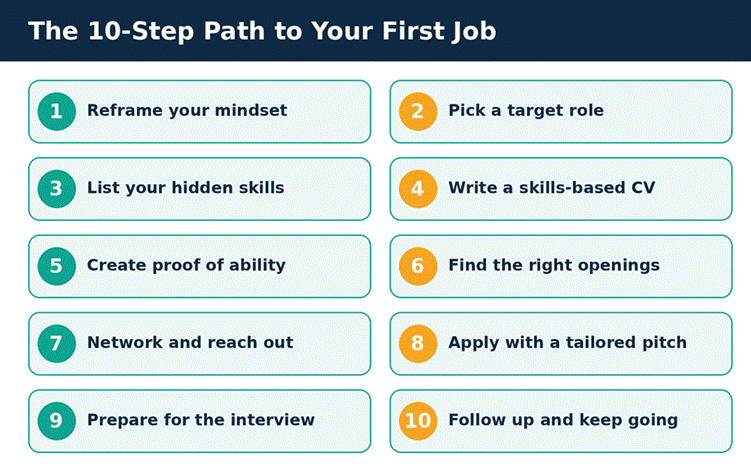
Step 2: Choose Your Target Role and Field
“I will take any job” sounds flexible, but it makes your applications weak. A focused applicant looks more serious than a scattered one. You do not need to pick your dream career for life, only a direction for the next six to twelve months.
How to choose in one evening
- Look at your interests: What do you enjoy reading, fixing, organising, or explaining?
- Look at your education: Which subjects or projects did you do best in?
- Browse real job posts: Search “junior”, “trainee”, “assistant”, “intern”, “associate” or “entry level” and note which titles repeat.
- Pick two roles: One main target and one backup, for example Customer Support Executive and Data Entry Assistant.
Common beginner-friendly fields include customer service, administration, sales support, social media and content, human resources assistance, retail and hospitality, accounts assistance, IT support, teaching assistance, and logistics coordination.
| I chose Human Resources because I have always been interested in understanding people, their careers, and how the right opportunities can change someone’s life. My professional journey in HR taught me that recruitment is not just about filling vacancies; it is about identifying potential and giving people a chance to grow. Over the years, I have conducted more than 1,000 interviews and worked with candidates from different backgrounds, including fresh graduates and experienced professionals. The fresh candidates who impressed me most were those who came prepared, communicated confidently, showed a willingness to learn, and understood the basics of the role they were applying for. One thing I have learned as an HR professional is that experience matters, but attitude, honesty, preparation, and learning ability can make a fresh candidate stand out. This is why I chose HR: because I want to connect people with opportunities and help them build better careers. |
Step 3: Discover the Skills You Already Have
This is the most important step in the whole guide. Most beginners say “I have no experience” because they only count paid work. Employers count skills, and you have picked up many of them in places you have not thought about.
Make your skills inventory
Take a sheet of paper and make four columns:
- Education: class projects, presentations, thesis, group assignments, lab work.
- Activities: clubs, sports teams, student societies, volunteering, community events.
- Informal work: helping in a family business, babysitting, tutoring, freelance favours, running an online page.
- Self-learning: online courses, YouTube tutorials, typing practice, languages, design or coding experiments.
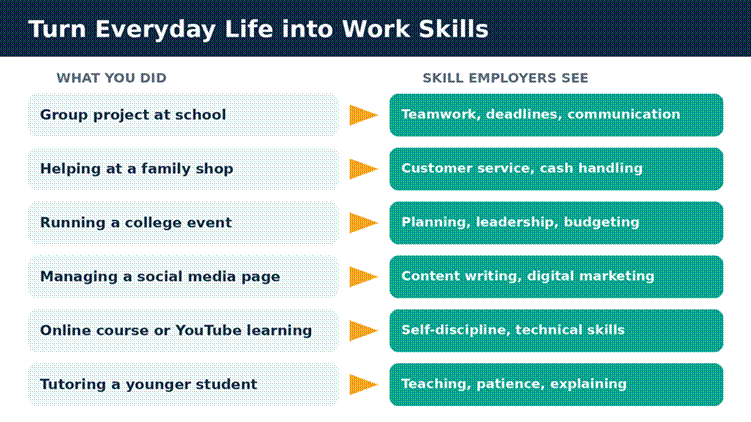
Under each item, write what you actually did and what it required. A group project means teamwork, deadlines, and communication. Helping at a shop means customer handling and responsibility. Organising a small event means planning, budgeting, and leadership.
Two kinds of skills to list
Hard skills are specific and teachable, such as Microsoft Excel, typing speed, basic design tools, a second language, or bookkeeping basics.
Soft skills are about how you work: communication, time management, problem solving, adaptability, honesty, and willingness to learn. For first jobs, soft skills often decide who gets hired.
| Throughout my HR career, I have developed several transferable skills through real workplace experiences: Communication and Relationship Building: During recruitment, I regularly interacted with candidates from different professional backgrounds. I learned how to understand their expectations, explain job requirements clearly, and maintain professional relationships. This helped improve the candidate experience and communication throughout the hiring process. Problem-Solving and Decision-Making: While handling HR operations, I faced situations involving employee attendance, workplace concerns, and policy misunderstandings. I listened to both sides, reviewed the available information, and worked toward practical solutions while maintaining fairness. Leadership and Team Support: I have supported new employees and junior colleagues during their onboarding process by explaining company policies, introducing them to workplace procedures, and guiding them through their initial responsibilities. I found that willingness to learn, positive communication, adaptability, and taking ownership were the qualities that helped new employees settle in successfully. These experiences taught me that skills such as communication, problem-solving, teamwork, adaptability, and leadership are valuable in almost every profession. |
Step 4: Write a Skills-Based CV
A normal CV starts with work history. Yours should start with strengths. This format is called a skills-based or functional CV, and it is perfectly acceptable for beginners.
Recommended CV structure
| Section | What to include |
| Header | Full name, phone, professional email, city and country, LinkedIn link |
| Professional summary | 2 to 3 lines: who you are, what role you want, your best strengths |
| Key skills | 6 to 8 skills matched to the job post |
| Projects and activities | Class projects, volunteering, events, personal work with results |
| Education | Degree or course, institution, year, notable grades or achievements |
| Certificates | Free or paid short courses relevant to the role |
| Languages and tools | Software, languages, typing speed |
Example summary for a beginner
“Motivated business graduate seeking an entry-level administrative role. Strong in Excel, written communication and time management, with hands-on experience organising university events for 200+ attendees. Eager to learn and contribute from day one.”
Write bullets that show results
Weak: “Helped in a family shop.”
Stronger: “Handled daily cash and customer queries at a family retail shop, serving 40+ customers a day with zero billing disputes.”
If you do not have exact numbers, use honest estimates such as “about”, “over”, or “weekly”. Never invent achievements. Employers check, and honesty protects your reputation.
CV rules that matter
- Keep it to one page for your first job.
- Use a clean font (Arial, Calibri) at size 10 to 12.
- Save and send it as a PDF unless the employer asks for Word.
- Use a professional email address, not a nickname.
- Check spelling twice, then ask someone else to check it again.
- Customise the key skills for each job by reusing words from the job post.
| During my HR and recruitment career, I have reviewed thousands of CVs, and one common mistake I frequently notice is that candidates focus too much on their job titles and responsibilities but fail to highlight their actual achievements and skills. I remember reviewing CVs from fresh graduates who had limited professional experience but presented their academic projects, internships, technical skills, and achievements very clearly. These candidates often made a stronger impression than those with lengthy CVs but no relevant details. One important lesson I have learned as a hiring professional is that a good CV is not about how many pages it contains; it is about how effectively it communicates your value. A clear professional summary, relevant skills, measurable achievements, and a well-organized format can make a significant difference. My advice to fresh candidates is simple: don’t try to make your CV look impressive with unnecessary information. Make it relevant, honest, professional, and easy for recruiters to understand. |
Step 5: Create Proof of Your Ability
When you have no job history, proof replaces it. Proof is anything a stranger can look at and say, “This person can do the work.” You can build it in two to four weeks, mostly for free.
Ten proof ideas that cost little or nothing
- Free online courses: Complete one or two short certificates connected to your target role.
- A mini project: If you want data entry, build a tidy Excel sheet. If you want content writing, write three sample articles. If you want customer support, write sample replies to common complaints.
- Volunteer work: Offer help to a local charity, school, mosque, church, or community group, and ask for a short reference.
- Internships and trainee programmes: Many companies offer them, and a paid or unpaid short internship still counts as real experience.
- Freelance microtasks: Small tasks for neighbours, small businesses or online marketplaces give you real feedback.
- A simple portfolio: A free page or a single shared folder with your best three samples is enough.
- Run a page or blog: Consistently posting about a topic you care about shows discipline and communication.
- Part-time or seasonal work: Retail, delivery, hospitality and events teach reliability and teamwork fast.
- Help a small business: Offer to manage their social media or records for a month and ask for a testimonial.
- Reference letters: A short signed note from a teacher, supervisor or community leader adds real trust.
Polish your LinkedIn profile
Many recruiters check LinkedIn before calling. Use a clear, friendly photo, a headline such as “Business Graduate | Excel | Customer Support | Open to Entry-Level Roles”, a short About section, and list your projects and certificates. Follow companies in your field and comment thoughtfully on posts.
| During my recruitment experience, I have come across fresh candidates who had limited professional experience but made a strong impression by presenting practical work. One example was a beginner who highlighted academic projects, internship experience, and independently completed assignments on their CV. Although the candidate did not have years of experience, their work demonstrated genuine interest, initiative, and the ability to apply what they had learned. As an HR professional, I personally find practical proof more convincing than simply listing skills on a CV. For example, a portfolio, completed project, internship certificate, relevant volunteer experience, or a real work sample can help demonstrate a candidate’s abilities. My advice to fresh graduates is not to wait until you get your first job to start building experience. Work on small projects, participate in internships, volunteer, and create something that demonstrates your skills. Sometimes, one practical project can make your application stand out from hundreds of others. |
Step 6: Find the Right Openings
Sending 100 random applications is less effective than sending 15 well-matched ones. Look in several places at once.
| Where to look | Why it works | Tip |
| Company career pages | Roles often appear here first | Make a list of 20 companies you like and check weekly |
| Job boards | Large number of entry-level listings | Use filters: entry level, trainee, junior, fresher |
| LinkedIn Jobs | Easy to see who posted the job | Message the recruiter after applying |
| University career offices | Employers trust their graduates | Attend job fairs and ask about alumni |
| Walk-ins and local businesses | Less competition, faster decisions | Dress well, carry printed CVs |
| Referrals | Referred candidates often get priority | Tell friends and family exactly what role you want |
| Internship and trainee programmes | Built for beginners | Apply early, deadlines are strict |
Read each job post slowly. If you meet about 60 to 70 percent of the requirements, apply anyway. Posts often list an ideal candidate that does not exist.
A quick safety note: never pay money to get a job, and be careful with offers that promise high salaries for easy work or ask for personal documents and bank details before an interview. Real employers do not charge applicants.
Step 7: Network and Reach Out
Many first jobs come from people, not portals. Networking does not mean being pushy. It means letting people know what you are looking for and asking for small, specific help.
Who to talk to
- Teachers, professors and mentors
- Family friends and relatives who work in offices or factories
- Seniors from your school or university
- Recruiters and HR professionals on LinkedIn
- People in your target field who share useful posts
A message you can adapt
“Hello [Name], I am a [degree] graduate interested in starting a career in [field]. I admire the work your team does at [company]. If there is an opening for a junior role, or if you could share one tip for beginners in this field, I would be very grateful. Thank you for your time.”
Keep messages short, polite and specific. Do not send your CV to strangers with no message at all, and never ask “Can you give me a job?” in the first line. Ask for advice first, and opportunities often follow.
| Throughout my HR career, I have seen how a simple professional conversation or referral can create valuable opportunities. I also receive messages from job seekers on LinkedIn. I usually respond to people who introduce themselves politely, share their qualifications, mention the role they are interested in, and attach their CV. I believe networking is about building genuine professional relationships, not simply asking someone for a job. |
Step 8: Apply with a Tailored Pitch
A tailored application takes ten extra minutes and doubles your chance of being noticed.
Your application checklist
- Read the job post and highlight the top five requirements.
- Match your key skills and projects to those five points.
- Rename your file professionally (Firstname_Lastname_CV.pdf).
- Write a short cover letter or email, three short paragraphs at most.
- Double-check the company name, role title and spelling.
- Track every application in a simple sheet: company, date, link, status.
Simple cover letter structure
- Paragraph 1: Who you are and the exact role you are applying for.
- Paragraph 2: Two or three strengths with a short example each.
- Paragraph 3: Why this company, plus a polite request for an interview.
Avoid copying cover letters from the internet. Recruiters see the same templates again and again. Your honest, slightly imperfect words are better than a perfect copy.
Step 9: Prepare for the Interview
Many first-time candidates lose offers not because they lack ability, but because nerves make them blank out. Preparation is the cure.
Questions almost every beginner is asked
- Tell me about yourself.
- Why do you want this job?
- What are your strengths and weaknesses?
- Why should we hire you with no experience?
- Describe a time you worked in a team or solved a problem.
- Where do you see yourself in five years?
- Do you have any questions for us?
Answering “Why should we hire you with no experience?”
“I may be new to full-time work, but I learn quickly and take responsibility seriously. During my university project, I led a team of four and we submitted ahead of schedule. I am ready to bring the same effort here and to learn your way of working from day one.”
Use the STAR method for story questions
- Situation: Set the scene briefly.
- Task: Explain what you were responsible for.
- Action: Describe what you personally did.
- Result: Share the outcome and what you learned.
Interview day basics
- Arrive 10 to 15 minutes early, or log in early for an online interview.
- Dress one level smarter than the workplace norm.
- Bring extra copies of your CV, a notebook and a pen.
- Greet everyone politely, including reception staff.
- Sit upright, make natural eye contact and speak slowly.
- Prepare two or three questions about training, team and expectations.
- Send a thank-you message within 24 hours.
If you feel anxious, remember that interviewers expect it from beginners. A calm breath before each answer and a short pause to think is a sign of maturity, not weakness.
| As an HR professional, I have interviewed many fresh candidates, and I am particularly impressed by beginners who communicate confidently, show curiosity, and demonstrate a willingness to learn. One thing that makes a candidate stand out is when they research the company, understand the job description, and connect their academic projects or internship experience to the role. One common mistake I notice is candidates attending interviews without researching the company or understanding the position they applied for. Some also struggle to explain their own CV. My advice is simple: prepare before every interview, be honest about what you know, and never pretend to have skills or experience you don’t possess. |
Step 10: Follow Up, Learn from Rejection and Keep Going
Most people hear “no” or nothing at all several times before they hear “yes”. This is normal, and it is not a verdict on your worth.
Follow-up that works
- Wait 5 to 7 days after applying, then send one polite follow-up email.
- Ask for feedback after an interview rejection and thank them either way.
- Keep notes on what questions surprised you and improve your answers.
- Reapply to the same company after six months if you have gained new skills.
When the first offer is not perfect
Your first job does not have to be your dream job. A modest salary, a smaller company or a short contract still gives you the one thing you are missing: real experience. After six to twelve months, you can say “I have experience” and a whole new set of doors opens.
| My early career journey taught me that getting your first opportunity is only the beginning. Like many professionals, I faced challenges, learned through mistakes, and gradually developed my skills in Human Resources. My early experiences taught me the importance of communication, patience, teamwork, and taking responsibility. One lesson I learned was not to be afraid of making mistakes because every challenge is an opportunity to improve. I believe fresh graduates should focus less on finding the perfect first job and more on finding a place where they can learn, contribute, and grow professionally. |
Your 30-Day Action Plan
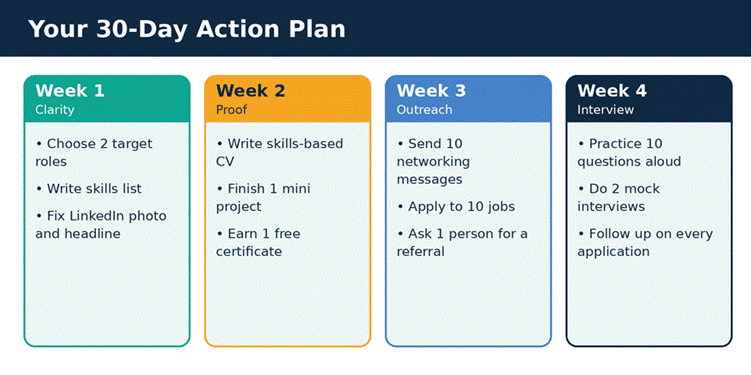
Print this or copy it into your notes. Small daily action beats a big plan that never starts.
Mistakes to Avoid
- Waiting to feel ready: You will never feel completely ready. Apply while you keep improving.
- Using one CV for every job: Always match your skills to the job post.
- Lying about experience: False claims are easy to check and can end your career before it starts.
- Ignoring small employers: Smaller companies often train beginners faster and give more responsibility.
- Having an unprofessional online presence: Recruiters look at social media. Clean it up.
- Giving up after ten rejections: Fifty applications and ten interviews before an offer is more common than people admit.
Frequently Asked Questions
Can I really get a job with no experience at all?
Yes. Entry-level, trainee and internship roles exist exactly for people without work history. Your task is to show skills, attitude and proof of learning.
Should I accept unpaid work?
Short, well-defined internships with learning and a reference can be worthwhile. Be cautious about long unpaid roles that look like free labour, and do not pay to get a position.
What if I have gaps in my education or time?
Be honest and brief. Explain what you did, such as family responsibilities, learning online or caring for someone, and focus on what you are doing now.
How many jobs should I apply to?
Aim for quality: ten to fifteen well-tailored applications a week is better than a hundred copy-paste ones.
Is a certificate enough?
A certificate helps, but a certificate plus a small project is much stronger because it shows you can apply what you learned.
How long will it take?
It varies by country, field and season. Many beginners find their first role within two to four months of focused effort, while some take longer. Keep improving every week.
Final Thoughts
Everyone who has a career today once had an empty CV. What separated them from those who waited was not talent or luck. It was the decision to start with what they had, show it clearly, and keep going after each rejection.
You do not need ten years of experience to deserve a chance. You need a clear target, honest proof of your skills, and the courage to knock on a few doors. Start with Step 1 today, and let your first job be the beginning of a story you are proud to tell.
Have a question or your own first-job story? Share it in the comments. It might be exactly what another beginner needs to read today.

About Muhammad Faisal
Muhammad Faisal is an HR professional with an MBA in Human Resources and six years of experience across diverse HR domains. Through HRGuide.site, he turns real-world HR knowledge into practical insights, career advice, interview tips, and valuable resources to help professionals grow and organizations thrive.