
Why Recruiters Don’t Call You After Applying for a Job
The honest reasons behind the silence, and a practical plan to start getting replies
You spent hours on your CV. You applied with hope. Then you waited. A day passed, then a week, then a month. Your phone stayed silent, your inbox stayed empty, and slowly the thought crept in: “Is something wrong with me?”
Before anything else, please hear this: silence after applying is one of the most common experiences in job hunting, and in most cases it says very little about your value as a person. It says more about how hiring works behind the scenes, and about a few fixable details in your application.
This article explains, honestly and without sugar-coating, why recruiters often do not call back, and gives you ten practical fixes you can start using today. It applies to job seekers in any country.
What you will learn
- What really happens to your application after you click Submit
- Ten common reasons you hear nothing
- Ten fixes that increase your chances of a call
- How and when to follow up without annoying anyone
- How to protect your confidence while you wait
| I have seen many job seekers apply for dozens of positions, update their CVs, attend interviews, and wait for responses, only to receive complete silence from employers. I understand how frustrating and discouraging this can be, especially when someone genuinely needs a job and puts so much effort into every application. Working in HR and recruitment, I have also seen how competitive the hiring process can become, with hundreds of applications sometimes received for a single vacancy. Behind every CV is a person hoping for an opportunity, and sometimes a simple rejection or even a response can make a big difference. |
What Really Happens After You Click “Apply”
Many candidates imagine a person reading each application carefully, thinking about it, and then deciding. The reality is usually very different.
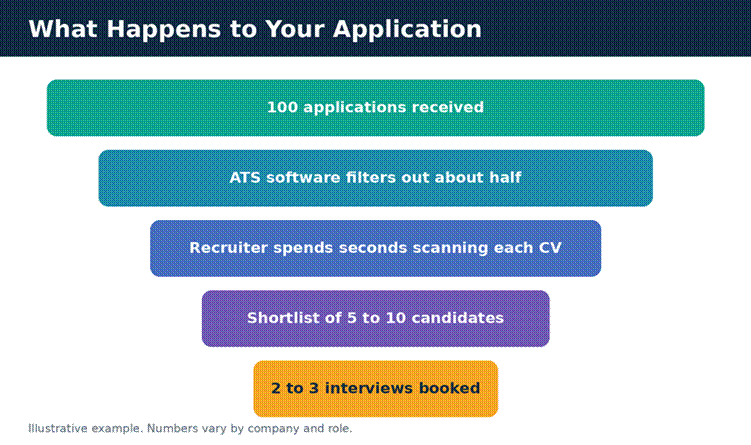
- Volume is huge. A single open role can attract hundreds of applications within days, especially online. One recruiter may handle many roles at the same time.
- Software may screen first. Many companies use an Applicant Tracking System (ATS) that sorts CVs by keywords, location, education or other filters before a person sees them.
- The first scan is fast. Recruiters often spend only a few seconds on an initial look. They are scanning for a quick match, not reading every line.
- Shortlists are small. Once a handful of good matches are found, the recruiter often stops reviewing and starts calling.
- No reply is the default. Because of volume, many companies cannot send a personal rejection to everyone. That does not make it fair or kind, but it is how the system often works.
| Working in HR and recruitment has given me a clear understanding of what happens behind the scenes. In a typical recruitment process, applications are first reviewed by HR to check candidates’ qualifications, experience, relevant skills, and suitability for the position. After initial screening, shortlisted CVs are shared with the hiring manager or concerned department for further evaluation. Depending on the urgency of the vacancy and the number of applications, shortlisting can take several days. I remember situations where I wished I could personally respond to every candidate who applied. Many applicants had taken the time to prepare their CVs and submit applications, but due to a high volume of applications, urgent hiring priorities, and limited time, responding individually was not always possible. It reminded me that behind every application is a person waiting for an opportunity. Even when HR cannot respond to everyone, candidates deserve respect, transparency, and a professional hiring experience. |
10 Common Reasons Recruiters Don’t Call
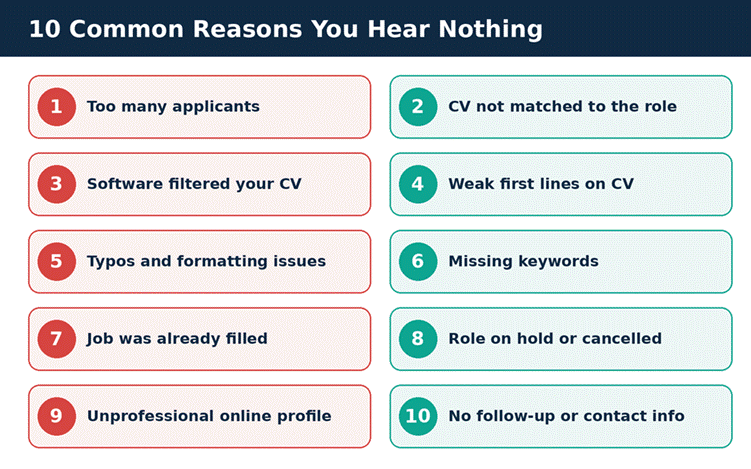
1. Too many applicants for too few spots
Even strong candidates get missed when the pile is large. This is the most common reason and the one least in your control.
2. Your CV is not matched to the role
A general CV sent to every job rarely fits any job well. If the post asks for “customer service” and your CV never mentions it, the recruiter moves on.
3. The ATS filtered your CV out
Fancy designs, tables, text boxes, photos and unusual fonts can confuse software. Missing keywords from the job post can also lower your ranking.
4. The first lines did not hook the reader
If your summary is vague (“hardworking person seeking a good opportunity”), the recruiter learns nothing about you in those critical first seconds.
5. Typos, bad formatting or a long CV
Spelling mistakes signal carelessness. Walls of text, inconsistent fonts and four-page CVs for a first job make scanning hard.
6. You do not clearly meet the basic requirements
Recruiters often have must-have criteria such as location, language, notice period, degree or a specific tool. Missing one can end the review.
7. The role was already filled or paused
Some posts stay online after the position is filled, and some roles are put on hold or cancelled with no announcement.
8. Internal candidates or referrals got priority
Many companies first look at employees or referred candidates. External applicants are reviewed after that, if at all.
9. Your online presence raised doubts
Recruiters may search your name. An empty or unprofessional profile, or public posts that clash with workplace values, can cost you a call.
10. Your contact details were hard to use
A wrong phone number, a full voicemail, an unprofessional email or no phone at all can quietly kill a good application.
| One of the most common reasons I have seen candidates get rejected is a mismatch between their CV and the actual job requirements. Sometimes candidates have good qualifications and relevant experience, but their CV does not clearly highlight the skills and achievements the employer is looking for. I once came across a promising candidate who had relevant experience for a position, but their CV was poorly structured, contained spelling mistakes, and did not clearly explain their responsibilities in previous roles. Although the candidate had potential, the first impression created by the CV was not strong enough to move forward in the recruitment process. This made me realize something important: sometimes candidates are not lacking skills or experience; they are simply not presenting themselves effectively. A few improvements in CV formatting, proofreading, and highlighting relevant achievements can make a significant difference. |
10 Fixes That Help You Get More Calls
Fix 1: Tailor your CV for each job
Read the job post and underline the top five requirements. Make sure your CV shows those five things in clear words. Ten minutes of tailoring beats an hour of mass-applying.
Fix 2: Use keywords honestly
If the post says “data entry”, “MS Excel” and “report preparation” and you truly have those skills, use the same words. Do not add skills you do not have.
Fix 3: Keep the format simple
Use one column, standard headings (Summary, Skills, Experience, Education), a plain font and a PDF or Word file as requested. Avoid heavy graphics, photos and tables that software may not read.
Fix 4: Make the top third of your CV count
Write a short summary that names your target role, your strongest skills and one proof point. A recruiter should understand who you are in five seconds.
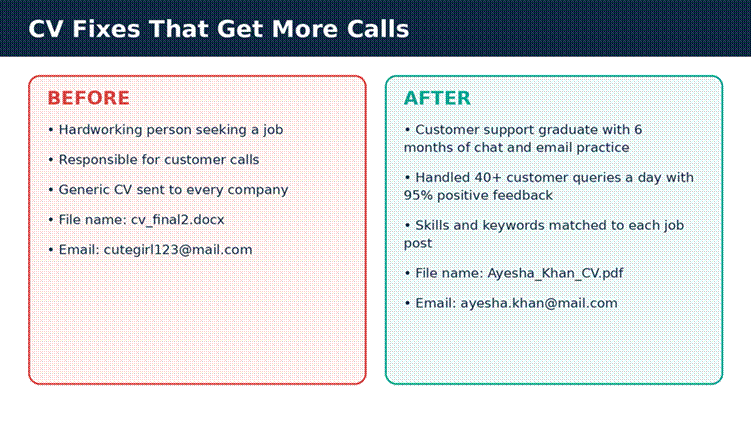
Fix 5: Show results, not duties
Instead of “responsible for sales”, write “closed 25 monthly sales worth about 1.2 million rupees” or a similar honest figure for your own currency and role. Numbers catch the eye.
Fix 6: Apply early and to the right roles
Applications sent in the first few days often get more attention. Focus on roles where you meet most requirements, rather than applying to everything.
Fix 7: Clean up your online presence
Update LinkedIn with a clear photo, a headline with your target role and skills, and a short About section. Check that public social media posts will not worry a future employer.
Fix 8: Get referrals
A referral can move you straight to the top of the pile. Tell friends, teachers, former colleagues and community contacts exactly which role you want. Ask politely and make it easy by sending your CV and a two-line summary.
Fix 9: Contact the recruiter directly
After applying, find the recruiter or hiring manager on LinkedIn and send a short, respectful message. For example:
“Hello [Name], I recently applied for the [role] position at [company]. My background in [skill] and [skill] matches the role, and I would be happy to share more details. Thank you for your time.”
Fix 10: Make yourself easy to reach
Use a working phone number, keep your phone charged and your voicemail clear, check your email and spam folder daily, and answer unknown numbers politely. Missed calls from recruiters are more common than you think.
| One CV improvement that I have seen make a real difference is replacing generic job responsibilities with specific achievements and measurable results. For example, instead of writing “Responsible for recruitment and employee management,” a candidate can write “Managed end-to-end recruitment, conducted 100+ interviews, and supported successful hiring across multiple departments.” This gives recruiters a much clearer picture of the candidate’s actual contribution. I also believe that a well-written LinkedIn or email message can create a positive first impression. Messages that get my attention are usually short, professional, and personalized. I appreciate candidates who mention the specific position they are applying for, briefly explain why their experience is relevant, and attach an updated CV. A genuine, focused message always stands out more than a copied message sent to dozens of recruiters. |
How and When to Follow Up
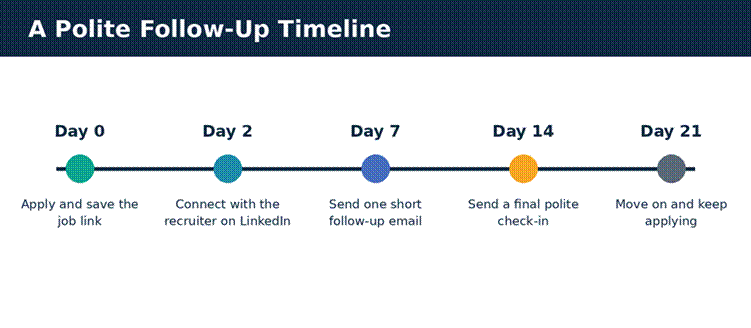
Following up shows interest and professionalism, as long as you do it politely and only a few times.
A short follow-up email you can adapt
Subject: Following up on [Role] application
“Dear [Name], I hope you are well. I applied for the [role] position on [date] and remain very interested in the opportunity. I believe my experience in [skill] would help your team with [goal]. Please let me know if you need any further information from me. Thank you for your time.”
Follow-up dos and don’ts
- Do wait at least 5 to 7 working days.
- Do keep messages short, polite and specific.
- Do thank them even if the answer is no.
- Don’t send daily messages or call repeatedly.
- Don’t show frustration or blame the recruiter.
- Don’t attach a new CV unless you were asked.
Protect Your Confidence While You Wait
Silence hurts, especially when you are putting in real effort. A few habits can protect your mind during the search.
- Treat it as a numbers game with a learning loop. Track your applications, review what you sent, and improve one thing each week.
- Do not take it personally. The recruiter has never met you. The silence is almost never a judgment about your character.
- Build a routine. Set specific hours for applying, learning and networking, and then switch off.
- Keep growing. A short online course or small project keeps your CV fresh and your mind active.
- Talk to someone. Share how you feel with a friend, mentor or family member. Job searching is much harder when done alone.
- Look after the basics. Sleep, food, movement and time outdoors are not luxuries. They keep your energy up for interviews.
| If you are applying for jobs and not receiving responses, I want you to know that your efforts are not worthless. I understand how difficult it feels to prepare your CV, apply for multiple positions, attend interviews, and then wait without hearing anything back. There may be days when you start questioning your abilities, but please don’t let an employer’s silence define your professional worth. As someone working in HR and recruitment, I want to share one thing: rejection does not always mean you are not capable. Sometimes it is about timing, competition, internal hiring decisions, or simply finding the right match. Keep improving your CV, developing your skills, networking with professionals, and applying strategically. Learn from every interview and every rejection, but never stop believing in your potential. Your next opportunity may come from an application you are about to submit. Stay patient, stay consistent, and keep moving forward. Your career journey is bigger than one unanswered email. A message from an HR professional: Don’t give up on yourself just because someone hasn’t replied to you yet. |
A Quick Checklist Before You Hit Apply
- My CV is tailored to this job post.
- The top five requirements appear clearly on my CV.
- My CV is one or two pages, in a plain format, with no typos.
- My phone number and email are correct and professional.
- My LinkedIn profile is updated.
- I have saved the job link and the date in my tracking sheet.
- I have planned a polite follow-up for day 7.
Frequently Asked Questions
Does no reply mean I was rejected?
Not always. It often means the company is still reviewing, has moved on without announcing it, or never reached your application. After about three weeks without news, it is reasonable to assume it did not progress.
How long should I wait before following up?
Between 5 and 7 working days is a good rule. If the post gives a closing date or timeline, wait until a few days after it.
Is it okay to message a recruiter on LinkedIn?
Yes, if you are polite and brief. Mention the exact role, one or two matching strengths, and thank them for their time.
Should I reapply to the same company?
Yes, for a different role or after six months, especially if you have gained new skills or experience.
Why do I get interviews rarely even with good experience?
Check keywords, CV layout, role fit and your online profile. Also consider whether you are applying to roles above or below your level. Ask a trusted friend or mentor to review your CV.
Can a bad social media presence stop calls?
It can. Many recruiters look up candidates. Keep public content respectful and make your professional profiles stronger than your personal ones.
Final Thoughts
Not hearing back is exhausting, but it is not the end of your story. Behind the silence there is usually a system with too many applications, too few hours and a quick first scan. The good news is that many of the causes can be fixed: a clearer CV, better keywords, a stronger profile, a referral and a polite follow-up.
Make one improvement today. Update your summary, fix your contact details or message one recruiter. Small, steady changes add up, and one day the phone you have been watching will finally ring.
Have you experienced this? Share your story in the comments. It may help someone who is feeling exactly the same way today.

About Muhammad Faisal
Muhammad Faisal is an HR professional with an MBA in Human Resources and six years of experience across diverse HR domains. Through HRGuide.site, he turns real-world HR knowledge into practical insights, career advice, interview tips, and valuable resources to help professionals grow and organizations thrive.