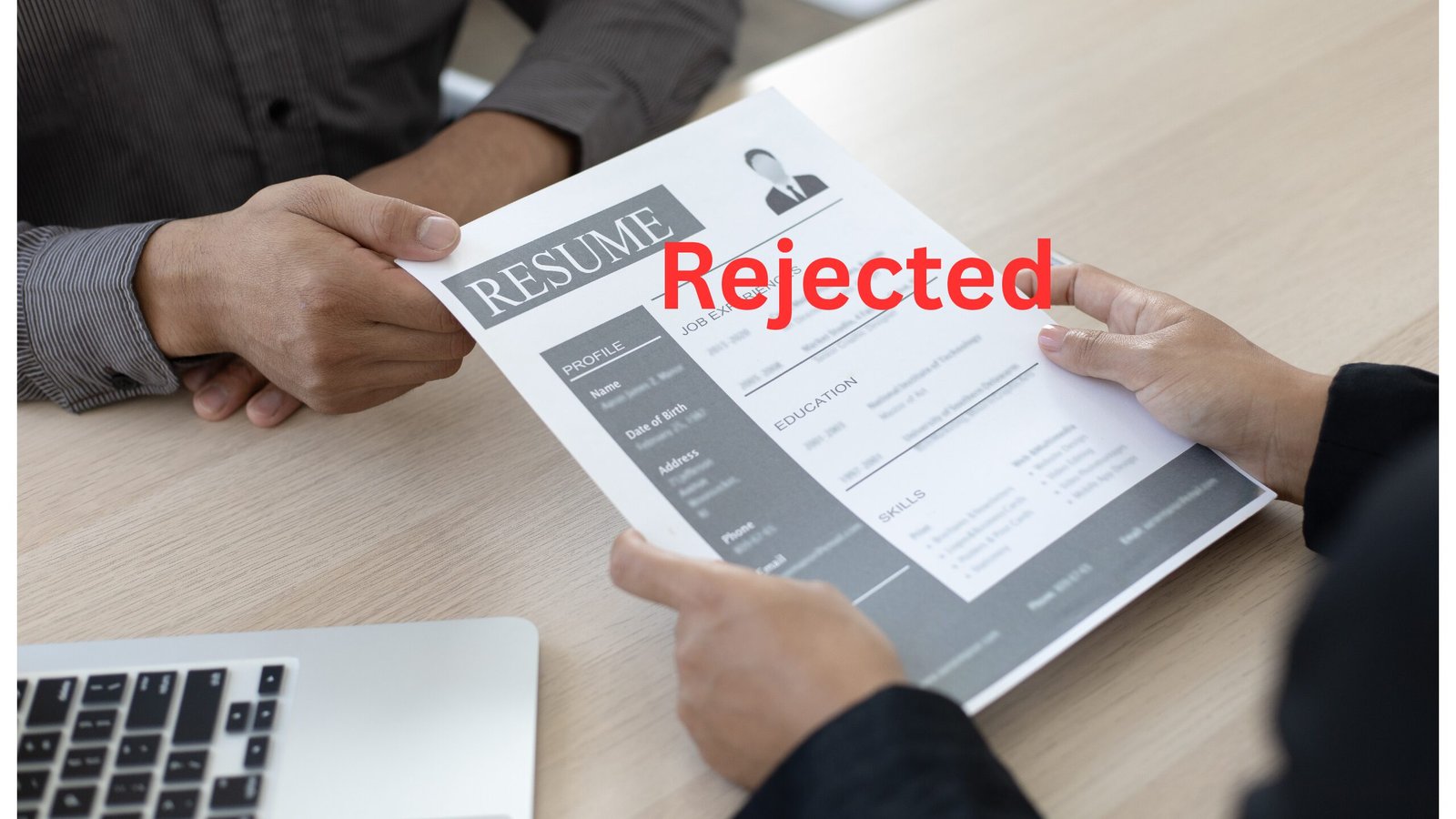
Why Your CV Gets Rejected: 12 Common Resume Mistakes and How to Fix Them
By Muhammad Faisal | HR Guide | Reading time: about 12 minutes
The Silence After You Hit “Send”
You spent three evenings on your CV. You checked every word, attached it, and pressed send. Then you waited. A day, a week, a month. No call, no email, not even a polite “no.”
That silence hurts more than a clear rejection, because it leaves you guessing. Was it your degree? Your experience? Bad luck? Most of the time it is none of those. It is a small, fixable mistake in the document itself.
Recruiters are busy people. A single opening can bring hundreds of applications, and many companies use software called an ATS (Applicant Tracking System) to sort them before a human ever looks. Your CV has to pass the software first and then win a quick scan from a tired reader. Small mistakes get you filtered out quickly.
The good news is that all 12 mistakes below can be fixed in one afternoon. Each one comes with a weak example, a strong example, and a simple fix you can copy.
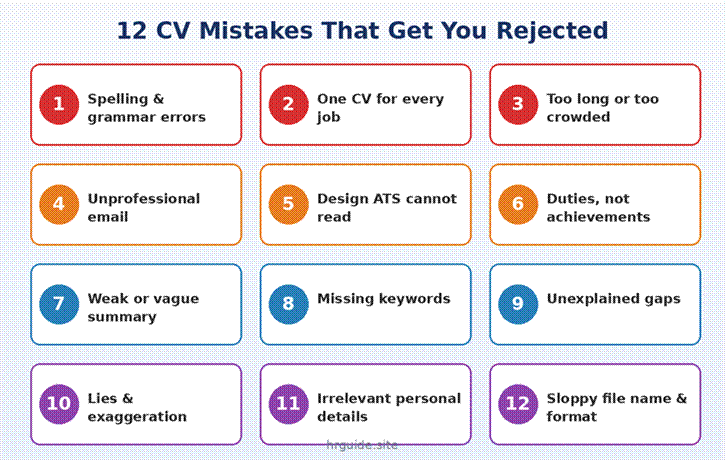
The 12 Common CV Mistakes (and Fixes)
Mistake 1: Spelling, Grammar and Typing Errors
One typo can make a recruiter think you do not pay attention to detail. For roles in HR, admin, accounts or customer service, they treat it as a serious warning sign.
| ✘ WEAK EXAMPLE Managment Trainee with good communcation skills. I have worked in 3 companys and handeled many task. |
| ✔ STRONG EXAMPLE Management Trainee with strong communication skills. Worked across three companies, handling daily operations and reporting. |
How to fix it: Run spell check, then read the CV out loud, line by line. Read it backwards once to catch typos. Ask a friend to read it too. Pay extra attention to company names, job titles and dates.
Mistake 2: Sending One Generic CV to Every Job
A CV that fits every job fits none. Recruiters want to see that you read their advertisement and understand what they need.
| ✘ WEAK EXAMPLE Objective: To obtain a challenging position in a reputed organization where I can utilize my skills. |
| ✔ STRONG EXAMPLE Summary: HR Executive with 4 years of experience in recruitment and payroll, applying for the HR Officer role at ABC Pvt Ltd. Reduced hiring time by 20% through structured screening. |
How to fix it: Keep one master CV with everything in it. For each application, copy it and keep only the experience and skills that match that job. Change the summary and the top three bullet points every time.
Mistake 3: A CV That Is Too Long or Too Crowded
Recruiters scan, they do not read. Four pages of small text hides your best points.
| ✘ WEAK EXAMPLE Four pages with every school project, a full list of every duty, and no white space. |
| ✔ STRONG EXAMPLE One page for fresh graduates and up to two pages for experienced professionals. Only the last 10 to 15 years of work. Short bullet points with space between sections. |
How to fix it: Cut anything that does not help you win this job. If an old role has nothing to do with the new one, reduce it to one line.
Mistake 4: Unprofessional Email Address and Missing Contact Details
Your email is the first thing a recruiter sees. A joke address creates a poor first impression, and a missing phone number makes you hard to reach.
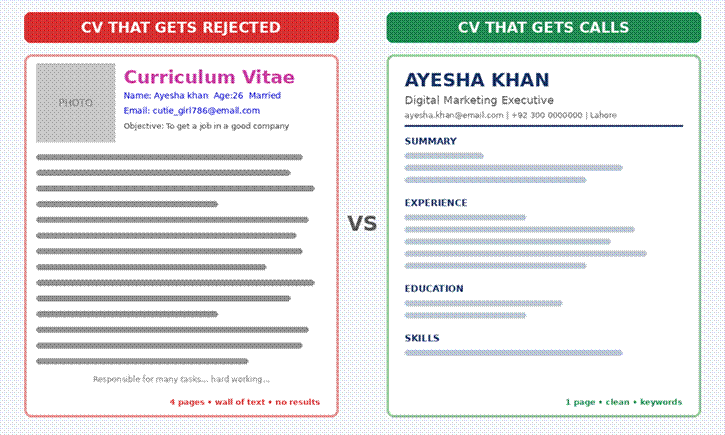
| ✘ WEAK EXAMPLE cutie_boy786@email.com | Phone: (missing) | Address: full house address |
| ✔ STRONG EXAMPLE ali.raza@email.com | +92 300 0000000 | Lahore, Pakistan | linkedin.com/in/aliraza |
How to fix it: Use a simple email with your name. Add a phone number with the country code, your city and a LinkedIn link. You do not need a full home address.
Mistake 5: Fancy Design That the ATS Cannot Read
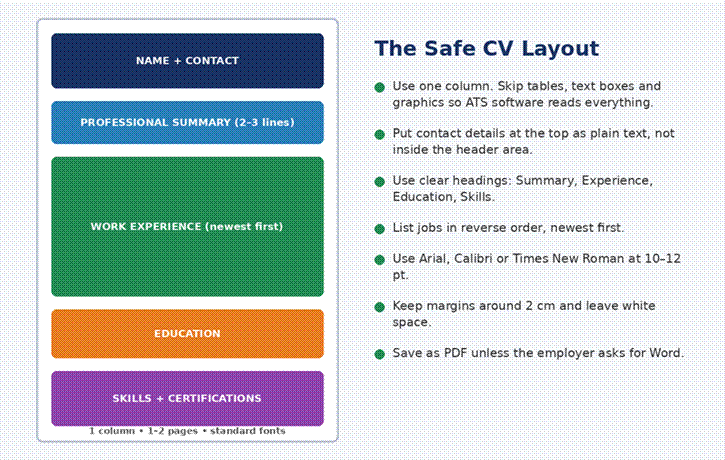
Two-column layouts, text boxes, icons, progress bars and photo frames look nice but often confuse ATS software. Your skills or job history can be read in the wrong order or skipped completely.
| ✘ WEAK EXAMPLE Skills shown as star ratings and bars: Excel ★★★★☆, English ●●●●○, placed inside a coloured side column. |
| ✔ STRONG EXAMPLE Skills written in plain text: Advanced Excel (pivot tables, VLOOKUP), Business English (written and spoken), Payroll software. |
How to fix it: Use one column, standard headings and common fonts. Star ratings are subjective and add nothing. Write your skills in words instead.
Mistake 6: Listing Duties Instead of Achievements
Anyone can write “responsible for.” Recruiters want proof that you did the job well. Numbers turn a claim into evidence.
| ✘ WEAK EXAMPLE Responsible for handling recruitment and attendance. |
| ✔ STRONG EXAMPLE Hired 35 staff in 6 months for 4 departments, and cut absenteeism by 15% by introducing a monthly attendance review. |
How to fix it: Use this formula for every bullet: Action verb + What you did + Result. If you do not have exact numbers, use honest estimates such as “about 50 candidates a month” or “team of 8.”
Mistake 7: A Weak or Vague Summary
The top of your CV is the most valuable space. Phrases like “hard working team player” say nothing, because everyone writes them.
| ✘ WEAK EXAMPLE Hard working and dedicated person looking for a good opportunity to grow. |
| ✔ STRONG EXAMPLE Accounts Assistant with 3 years of experience in invoicing, bank reconciliation and monthly reporting. Skilled in Excel and QuickBooks. Looking to support the finance team at a growing manufacturing company. |
How to fix it: Write 2 to 3 lines covering who you are, your strongest skills and what you want to do for this employer.
Mistake 8: Missing the Keywords from the Job Advertisement
ATS software looks for words from the job post. If the ad says “talent acquisition” and your CV only says “hiring,” you may rank lower.
| ✘ WEAK EXAMPLE Job ad asks for: payroll processing, HRIS, labour law compliance. Your CV says: handled salary and files. |
| ✔ STRONG EXAMPLE Processed monthly payroll for 250 employees using an HRIS, and ensured labour law compliance during audits. |
How to fix it: Read the ad and underline the skills and tools it repeats. Use those exact words in your summary, skills section and bullets, but only where they are true.
Mistake 9: Unexplained Employment Gaps and Messy Dates
Gaps are normal. Hidden or confusing dates are the problem, because they make recruiters suspicious.
| ✘ WEAK EXAMPLE Dates written as: 2019-ish to 21, then nothing until 2023. |
| ✔ STRONG EXAMPLE Mar 2019 – Dec 2021: Sales Executive, XYZ Ltd. Jan 2022 – Nov 2022: Career break, caring for family; completed an online HR certification. |
How to fix it: Use the same date format everywhere (Month Year). Add one short, honest line for any gap longer than six months. Mention courses, freelance work or family responsibilities if they are true.
Mistake 10: Lying or Exaggerating
Many employers verify degrees, job titles and references. Even if a lie gets past screening, it can cost you the job later and damage your name in a small industry.
| ✘ WEAK EXAMPLE Fluent in 5 languages. Managed a team of 50. (Reality: basic knowledge, team of 5.) |
| ✔ STRONG EXAMPLE Business English (fluent), Urdu (native), Arabic (basic). Led a team of 5 sales representatives. |
How to fix it: Be confident but accurate. A real achievement, described well, beats a big claim you cannot defend in an interview.
Mistake 11: Irrelevant or Risky Personal Information
Details such as religion, marital status, father’s name, salary history and height do not help you pass screening. In many countries, employers are not allowed to ask for them, and they can invite bias.
| ✘ WEAK EXAMPLE Father’s name, religion, marital status, date of birth, CNIC number, current salary, height and weight. |
| ✔ STRONG EXAMPLE Name, phone, email, city and LinkedIn only. Add a photo only if the country or employer specifically asks for one. |
How to fix it: Keep the CV about your work. If a company application form asks for personal details, give them there. They do not belong on your CV. Never put ID numbers on a CV that you send out widely.
Mistake 12: Careless File Name, Format and Inconsistent Styling
A file named CV_final_final2_NEW(1).docx looks careless. Mixed fonts, uneven spacing and a photo of a printed CV hurt the reader’s experience.
| ✘ WEAK EXAMPLE File: CV_final2_NEW(1).docx. Three different fonts, bullets that do not line up, sent as a phone photo. |
| ✔ STRONG EXAMPLE File: Ayesha_Khan_CV.pdf. One font, consistent bullets and spacing, sent as a PDF unless the employer asks for Word. |
How to fix it: Name your file “Firstname_Lastname_CV.” Use one font and one date style. Open the final file on your phone and computer to make sure nothing shifts.
| My Experience as an HR Professional A while ago, my team was hiring for one HR Officer position. We received more than 150 applications within a week. When I started screening, I noticed something that still stays with me: the strongest candidate on paper was not the one at the top of the pile. One applicant had four years of relevant experience and a good degree. But his CV was a generic one. The summary said “seeking a challenging position in a reputed organization,” his email address was a nickname, and his bullet points listed duties like “responsible for recruitment” with no results. Another candidate with less experience wrote a clear summary, used the keywords from our job advertisement and showed numbers, such as “hired 20 staff in 3 months.” Her CV took me 20 seconds to understand, so she got the interview call. I later spoke to the first candidate. His experience was real, but his CV hid it. After he rewrote it with achievements and a proper structure, he got interviews at two other companies within a month. That is why I always tell candidates: your CV should not just describe your experience, it should show your value. |
Best CV Formats: Which One Should You Use?
There are three common formats. Most people should use the first one.
| Format | Best for | How it works |
| Reverse-chronological | Most job seekers, especially with steady experience | Lists your latest job first and goes backward. Recruiters and ATS software like it most. |
| Functional (skills-based) | Rare cases, such as major career change | Groups achievements by skill instead of by job. Some recruiters distrust it because it can hide dates. |
| Combination (hybrid) | Career changers or people with strong skills and some gaps | A skills summary at the top, then a short reverse-chronological job history below. |
Free CV Template You Can Copy (Experienced Candidate)
Fresh Graduate Version (No Experience Yet)
If you have no job history, move Education higher and show projects, internships and volunteering as your experience.
Action Verbs That Make Bullets Stronger
| For results | For leadership | For work with people |
| Increased, Reduced, Saved | Led, Managed, Supervised | Coordinated, Supported, Trained |
| Improved, Delivered, Achieved | Organised, Directed, Mentored | Recruited, Resolved, Advised |
Quick Pre-Send CV Checklist
- ☐ No spelling or grammar mistakes (read it aloud).
- ☐ Professional email and correct phone number.
- ☐ One to two pages, one column, simple font.
- ☐ Summary matches this specific job.
- ☐ Bullets show results, with numbers where possible.
- ☐ Keywords from the job ad are included honestly.
- ☐ Dates are consistent and gaps are explained.
- ☐ No unnecessary personal details or ID numbers.
- ☐ File named Firstname_Lastname_CV and saved as PDF.
- ☐ Opened on phone and computer to check the layout.
Frequently Asked Questions
How long should a CV be?
One page for fresh graduates, one to two pages for experienced candidates. Only senior leaders or academics normally need more.
Should I add a photo?
It depends on the country. In many regions, including the US, UK and Canada, a photo is not recommended. In some countries it is normal. Follow the local custom or the employer’s request.
Is a CV the same as a resume?
They are similar. In the US and Canada, “resume” is a short document. In the UK, Pakistan and many other countries, “CV” is the common word, and the content is almost the same.
Should I write an objective or a summary?
A summary works better. It focuses on what you offer the employer, not what you want.
PDF or Word?
PDF keeps your layout safe, and most ATS systems read it well. Send Word only if the employer asks for it.
Do I need a cover letter?
If the employer allows it, yes. A short, tailored letter explains your motivation and sets you apart.
Final Thoughts: A Rejection Is Not the End
A rejected CV does not mean you are not good enough. It usually means your document did not show your value clearly, quickly, or in a form the system could read. That is fixable.
Take the 12 mistakes above, check your CV against them tonight, and send one improved application tomorrow. You may be surprised how fast the silence turns into an interview call.
Which of these mistakes have you made? Share your experience in the comments below.
| Early in my HR career, I learned that recruiters don’t always have time to understand every detail of a CV. They scan for relevant skills, experience, achievements, and job requirements. That experience taught me an important lesson: A good CV doesn’t just tell your career story; it makes a recruiter want to know more about you. |

About Muhammad Faisal
Muhammad Faisal is an HR professional with an MBA in Human Resources and six years of experience across diverse HR domains. Through HRGuide.site, he turns real-world HR knowledge into practical insights, career advice, interview tips, and valuable resources to help professionals grow and organizations thrive.