
How to Crack Any Job Interview: A Heartfelt Step-by-Step Guide
Your hands are cold. Your heart is racing. You have rehearsed your answers a hundred times in the mirror, and still a small voice whispers: “What if I am not good enough?”
If you have ever felt this way before a job interview, please know that you are not alone, and you are not weak. You are simply someone who cares deeply about a chance that could change your life. That caring is not your problem. It is your power.
In this guide, you will learn how to crack any job interview with a clear, human, step-by-step plan: what to prepare, what to say, how to handle the hardest questions, and how to stay calm when it matters most. No tricks. No fake confidence. Just honest preparation and a steady heart.
Why Interviews Feel So Scary (and Why That Is Normal)

An interview is one of the few moments in life when a stranger is allowed to ask about your past, your strengths and your weaknesses, and then decide something about your future. Of course it feels heavy.
Behind every candidate, there is a story. Maybe it is a graduate who has sent fifty applications and heard nothing back. Maybe it is a parent returning to work after a long break. Maybe it is someone who was laid off and is quietly carrying the fear of starting over. When the interview invitation finally arrives, so much hope rides on one conversation.
Here is the truth that changes everything: the people interviewing you are not looking for a perfect person. They are looking for a capable, honest and likeable person who can solve their problem. Once you understand this, the fear starts to loosen its grip.
If anxiety is your biggest struggle right now, read our practical guide on managing anxiety before a job interview, then come back to this plan.
Step 1: Understand What the Interviewer Is Really Asking
Every interview question, however it is worded, quietly asks one of three things:
- Can you do the job? (skills, experience, knowledge)
- Will you work hard and stay committed? (motivation, attitude, reliability)
- Will you fit with our team? (communication, honesty, character)
When you prepare an answer, ask yourself: “Which of these three is this question about?” Your answers will instantly become clearer and more focused.
Step 2: Research the Company Like You Already Want to Belong There
Nothing impresses an interviewer more than a candidate who clearly cares. Before the interview, spend an hour learning about the organization:
- What does the company do, and who are its customers?
- What are its values, recent news or new projects?
- Who will be interviewing you? (A quick look at their professional profile helps.)
- What problems might this role be hired to solve?
Write down two or three things that genuinely excite you about the company. When you say, “I was inspired by your recent project because…”, you stop sounding like just another applicant and start sounding like a future teammate.
Step 3: Read the Job Description Like a Map
The job advertisement is a free cheat sheet. Underline the skills and responsibilities mentioned most often. Then, for each one, write down a real example from your life: a job, an internship, a university project, volunteering, or even a family responsibility you handled well.
If your CV needs polishing before you walk in, explore our CV and career development guides so your paper matches your potential.
Step 4: Master the STAR Method for Every “Tell Me About a Time…” Question

Behavioral questions such as “Tell me about a time you faced a challenge” scare many people because they feel open-ended. The STAR method turns them into a simple recipe:
- S – Situation: Set the scene briefly.
- T – Task: Explain what you were responsible for.
- A – Action: Describe exactly what you did (say “I”, not only “we”).
- R – Result: Share the outcome, and use numbers or specific details if you can.
A Simple STAR Example
Question: “Tell me about a time you handled a difficult customer.”
Answer: “In my last role, a customer was upset because their order arrived late (Situation). I was responsible for resolving the complaint before it became a cancellation (Task). I listened without interrupting, apologized sincerely, tracked the delay, and arranged a priority replacement the same day (Action). The customer thanked me, kept ordering, and later left positive feedback for our team (Result).”
Prepare three to five stories like this. One strong story can often answer many different questions.
What Do People Really Want to Learn About Job Interviews?
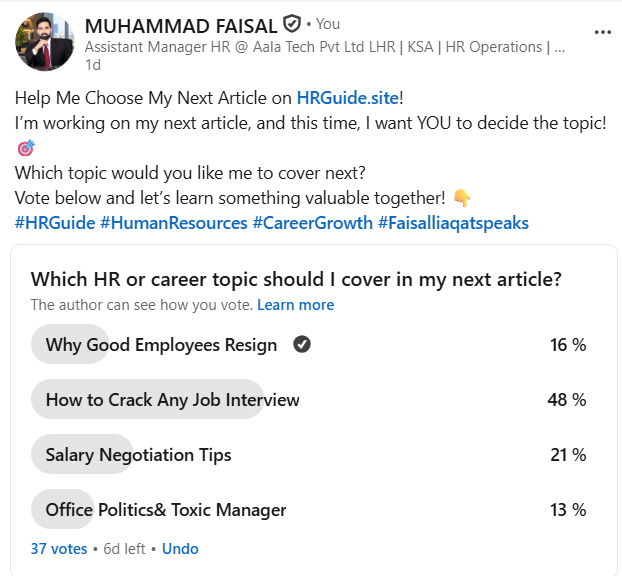
Recently, I conducted a poll on LinkedIn to understand which HR and career topics people want me to cover next on HRGuide.site.
The results caught my attention!
Out of 37 votes, 48% of respondents chose “How to Crack Any Job Interview” as their preferred topic.
Here’s the complete breakdown:
- How to Crack Any Job Interview: 48%
- Salary Negotiation Tips: 21%
- Why Good Employees Resign: 16%
- Office Politics & Toxic Managers: 13%
What Does This Poll Tell Us?
From my personal experience in Human Resources and recruitment, I understand that job interviews can be stressful for candidates. People want practical guidance on how to introduce themselves, answer difficult questions, communicate confidently, and convince recruiters that they are the right fit for a role.
This poll reinforces my belief that candidates need more than theoretical advice. They need practical strategies, real-world examples, and insights into what recruiters actually look for during interviews.
That is exactly what I aim to share through HRGuide.site.
My message to job seekers: You don’t need perfect answers to succeed in an interview. You need preparation, confidence, clear communication, and a strong understanding of the role you’re applying for.
Let’s make your next interview a better one!
Step 5: Prepare for the Questions Everyone Gets Asked
You can never predict every question, but a handful appear again and again. Prepare honest, personal answers for these:
“Tell me about yourself.”
This is not your life story. Use a simple Present – Past – Future structure: what you do now, what experience brought you here, and why this role is your next step. Keep it under two minutes.
“Why do you want this job?”
Connect your strengths to their needs. Mention something specific about the company, then explain how the role fits your growth.
“What are your strengths?”
Choose two or three strengths that match the job, and back each one with a short example. Proof is always stronger than adjectives.
“What is your biggest weakness?”
Be honest but wise. Choose a real weakness that is not critical for the role, then show what you are doing to improve it. For example: “I used to struggle with public speaking, so I joined a small practice group, and now I present to my team every month.”
“Why did you leave your last job?” or “Why is there a gap in your CV?”
Stay calm, truthful and forward-looking. Never speak badly about a previous employer. You can say: “I was looking for new challenges and growth,” or explain a gap simply, for example family responsibilities, study, health recovery or job searching, and then pivot to what you learned or how you stayed active.
“Where do you see yourself in five years?”
Show ambition without sounding like you are leaving tomorrow. Talk about growing your skills, taking on responsibility and contributing more deeply to the team.
Step 6: Practice Out Loud, Not Just in Your Head
Thinking about answers and speaking them are two very different skills. Your mind may feel confident, but your voice needs training too.
- Practice your answers out loud at least three times.
- Record yourself on your phone and listen for filler words (“um”, “like”, “you know”).
- Ask a friend or family member to run a mock interview.
- Practice your opening and closing the most. First and last impressions stay longest.
You do not need to memorize word for word. You only need to know your key points so well that you can speak them naturally.
Step 7: Prepare for the Day Itself
Small details protect your confidence. The night before:
- Choose and prepare your outfit. Aim for clean, neat and professional.
- Print several copies of your CV, and carry a notebook, a pen and your documents.
- Check the address, route and travel time. Plan to arrive 10 to 15 minutes early.
- For online interviews, test your camera, microphone, internet and lighting in advance, and sit somewhere quiet with a simple background.
- Sleep well. A rested mind answers better than a mind full of last-minute cramming.
Step 8: Win the First Five Minutes and Stay Calm Inside the Room
The interview begins the moment you arrive, including how you speak to the receptionist. Smile, greet everyone politely, offer a steady handshake if appropriate, and make comfortable eye contact.
If your nerves rise, try this quiet reset: breathe in slowly for four counts, hold for four, and breathe out for six. Do it twice before you walk in, or even once at the table. Then remind yourself of one sentence:
[IMAGE 4: interview-mindset-quote.webp. Alt text: Interview mindset reminder: they are not here to judge you, they are here to meet you. Caption: Walk in as a person, not a performance.]
During the conversation:
- Listen fully before you answer. It is perfectly fine to pause for a few seconds and think.
- Be honest. If you do not know something, say so, and explain how you would find the answer.
- Keep answers focused, usually one to two minutes each.
- Use positive body language: sit upright, keep your hands relaxed and nod to show you are listening.
- Be yourself. Real warmth beats rehearsed perfection every time.
Ask Smart Questions at the End
When they ask, “Do you have any questions for us?”, never say “No.” Try one or two of these:
- “What does success look like in this role in the first six months?”
- “What are the biggest challenges the team is facing right now?”
- “How would you describe the team culture?”
- “What are the next steps in the hiring process?”
Good questions show curiosity, maturity and genuine interest.
Step 9: Follow Up With Gratitude
Within 24 hours, send a short thank-you email. Thank them for their time, mention one thing you enjoyed discussing, and restate your interest in the role. It takes five minutes, and it leaves a warm, professional final impression.
Common Interview Mistakes to Avoid
- Arriving late or unprepared.
- Knowing nothing about the company.
- Speaking negatively about a past employer or colleagues.
- Giving very long, unfocused answers.
- Checking your phone or letting it ring during the interview.
- Exaggerating or lying about your experience. Small lies tend to grow into big problems.
- Forgetting to ask any questions at the end.
What If You Do Not Get the Job?
Let us talk about this gently, because it matters. Sometimes you will do everything right and still hear “We have chosen another candidate.” It hurts. It is perfectly human to feel disappointed, and you deserve a moment to feel it.
But a rejection is not a verdict on your worth. Often it is about timing, budget, internal candidates or a very small difference between strong applicants. Every interview teaches you something: a question to prepare better, a story to sharpen, a calm you did not have before.
After each interview, write down what went well and what you would improve. Then keep going. Many successful professionals will tell you that their best job came after a few “no” answers. Keep applying through our latest jobs in Pakistan page, and keep growing with more articles in our interview preparation section.
Quick Interview Checklist
- I researched the company, the role and the interviewers.
- I prepared three to five STAR stories.
- I practiced my answers out loud.
- My outfit, documents and route are ready.
- I have two or three thoughtful questions to ask.
- I will send a thank-you email within 24 hours.
Frequently Asked Questions (FAQs)
How do I crack a job interview on the first try?
Prepare thoroughly, know the company and the role, practice your answers out loud using the STAR method, and stay honest and calm. Preparation builds confidence, and confidence is what interviewers remember.
What should I say in the first minute of an interview?
Greet warmly, thank the interviewer for their time, and when asked to introduce yourself, share a short Present – Past – Future summary that shows why you are a good fit for the role.
How can I stop being nervous before an interview?
Practice out loud, arrive early, use slow breathing before you go in, and remember that the interviewer wants you to do well. A little nervousness is normal and can even sharpen your focus.
How long should my interview answers be?
Most answers work best at one to two minutes. Give a clear point, a short example and a result, then stop and let the interviewer guide the conversation.
What should I wear to a job interview?
Dress one step above the company’s everyday dress code. Neat, clean and comfortable clothing helps you feel confident and look professional.
Is it okay to say “I don’t know” in an interview?
Yes, when it is true. Honesty is respected. Follow it with how you would find the answer or learn the skill, which shows problem-solving and a willingness to grow.
Final Thoughts: You Are More Ready Than You Think
Cracking a job interview is not about becoming someone else. It is about showing the best, most prepared and most genuine version of yourself. You have already survived difficult days, learned new skills and kept hoping. That strength is exactly what employers need.
So take a breath. Prepare with care. Walk in with respect for yourself and for the people across the table. And whatever the result, remember: you are growing with every step, and the right opportunity is still on its way to you.
For more guidance, read our companion guide Mastering Job Interviews: Proven Tips for Success, and share this article with a friend who has an interview coming up. Your kindness might be the encouragement they need today.
Disclaimer: This article is for general career guidance. Hiring practices vary by company and country, so always follow the specific instructions provided by your employer.

About Muhammad Faisal
Muhammad Faisal is an HR professional with an MBA in Human Resources and six years of experience across diverse HR domains. Through HRGuide.site, he turns real-world HR knowledge into practical insights, career advice, interview tips, and valuable resources to help professionals grow and organizations thrive.