
How to Pass a Final Interview With an HR Manager
By Muhammad Faisal | Last updated: November 2026 | Reading time: about 9 minutes
You have cleared the CV screening. You have survived the phone call. You have answered the technical questions. Now there is one last door: the final interview with the HR manager.
Many candidates relax at this stage. They think, “The hard part is over.” That is exactly when offers are lost. The final interview is not a formality. It is the moment the company decides whether to trust you with a real job, a real salary, and a place in the team.
This guide walks you through the whole process, step by step, in simple language. You will learn what the HR manager is really looking for, how to answer the toughest questions, how to talk about salary without fear, and how to close the interview so they remember you.
I remember sitting in final interviews where candidates had strong CVs and technical knowledge, but nervousness affected their confidence. Sometimes, the way they communicated, handled pressure, and answered unexpected questions made the biggest difference. Over the years, I have learned that a final interview is not just about qualifications; it is also about confidence, attitude, and how well you present yourself.
What Is a Final Interview With an HR Manager?
A final interview is the last round before a job offer. Earlier rounds usually test your skills. The final round with HR tests something different: fit, honesty, attitude, and risk.
The HR manager is quietly asking five questions:
- Will this person stay, or leave after three months?
- Will they get along with the manager and the team?
- Are their expectations (salary, role, growth) realistic?
- Is everything on their CV and in their earlier answers true?
- Will they represent the company well?
When you understand these hidden questions, every answer becomes easier.
First Interview vs Final Interview
| First Interview | Final Interview with HR | |
| Main goal | Check skills and basic fit | Confirm fit, values, and expectations |
| Who is present | Recruiter or department manager | HR manager, sometimes with a senior leader |
| Typical topics | Experience, technical knowledge | Motivation, salary, notice period, culture, career goals |
| Your mindset | Prove you can do the job | Prove you are the right person to hire |
Step 1: Understand What the HR Manager Is Really Deciding
Before you prepare answers, change how you see the meeting. The HR manager is not your opponent. They already like enough about you to bring you this far. Their job now is to remove doubt.
So your goal is simple: make it easy for them to say yes. Be clear, be honest, and be consistent with what you said before.
From my experience in HR, I have learned that honesty and attitude often matter more than giving perfect answers. I have seen candidates make a stronger impression by openly admitting what they don’t know and showing a willingness to learn. A confident candidate is good, but a humble and honest candidate is even more valuable.
Step 2: Review the Job and Your Earlier Interviews
The biggest final-round mistake is giving answers that do not match what you said before. HR managers read the notes from earlier interviewers. If you told the first interviewer you love fieldwork and now say you prefer desk work, that is a red flag.
Spend one hour on this review:
- Re-read the job description line by line.
- Write down the three most important duties in the role.
- Recall what you told earlier interviewers about your experience, salary, and notice period.
- Visit the company website and read the About, Values, and News pages.
- Look up the HR manager on LinkedIn, if the name is shared. Note their background.
- Find one recent company achievement you can mention naturally.

Step 3: Build Your Story Bank
HR managers love real examples more than perfect speeches. Prepare five short stories from your life or work that you can reuse for many questions. Use the STAR method:
- S (Situation): What was happening?
- T (Task): What was your responsibility?
- A (Action): What exactly did you do?
- R (Result): What changed because of you? Use numbers if you can.
Prepare one story for each of these themes:
- A time you solved a difficult problem
- A time you worked with a difficult person
- A time you made a mistake and fixed it
- A time you learned something quickly
- A time you went beyond your normal duty
Example of a short STAR answer:
Situation: I was handling recruitment for multiple departments where hiring delays were affecting operations.
Task: I needed to fill vacancies quickly without compromising candidate quality.
Action: I streamlined shortlisting, conducted structured interviews, and coordinated closely with hiring managers.
Result: I successfully managed 1,000+ interviews throughout my HR career and improved my ability to identify suitable candidates efficiently.
Step 4: Prepare for the Most Common Final-Round Questions
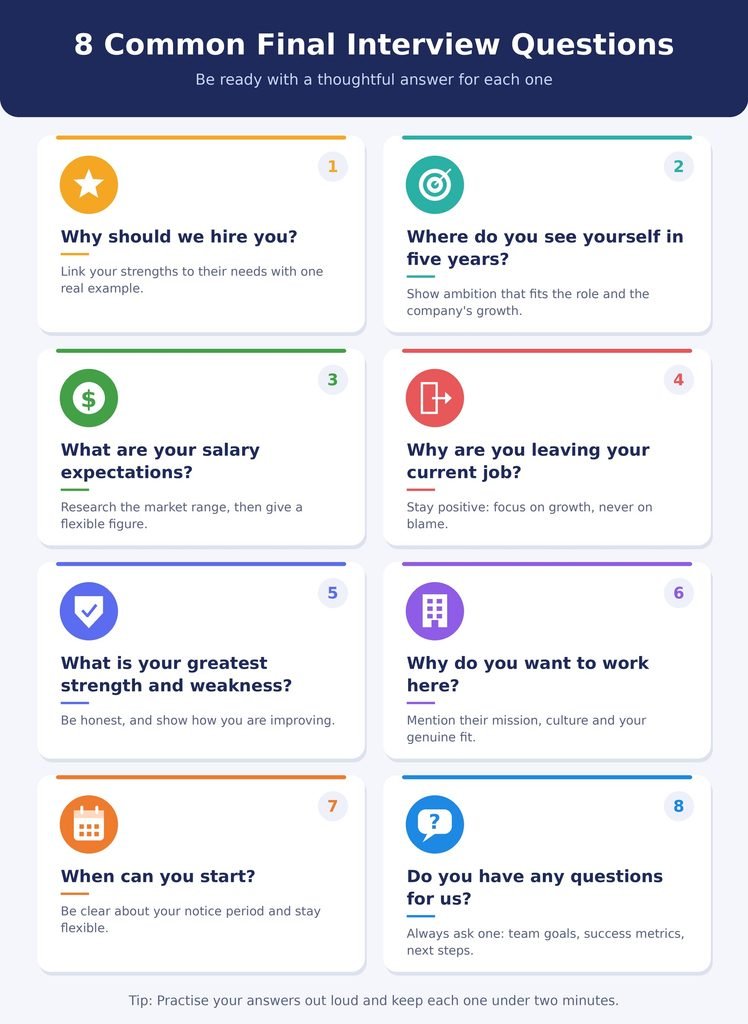
Below are the questions HR managers ask most often, what they really want to know, and a sample answer structure. Do not memorize these word for word. Use them as a pattern and fill in your own facts.
1. “Why do you want to join our company?”
What they want to know: Did you do your research? Are you excited about this company or just any job?
Sample answer: “I have followed your growth in the last two years, especially your move into new markets. I want to work in a company that values structure and learning, and my experience in recruitment fits what this team needs. I also liked that your values mention teamwork, because that is how I work best.”
2. “Why are you leaving your current job?”
What they want to know: Are you a complainer? Will you speak badly about us one day?
Sample answer: “I have learned a lot in my current role, and I am grateful for it. But I have reached a point where I want more responsibility and a wider scope, and this position offers that.”
Tip: Never criticize your boss or company, even if it is true. Stay positive and forward-looking.
3. “What are your strengths and weaknesses?”
Sample answer: “My strength is organizing work under pressure. My weakness was that I used to take on too much myself. I am learning to delegate and ask for help earlier, and it has already improved my results.”
Tip: Choose a real weakness that you are actively improving. Avoid fake answers like “I work too hard.”
4. “Where do you see yourself in five years?”
What they want to know: Will you stay? Are your goals realistic?
Sample answer: “I want to grow into a role with more ownership, ideally leading a small team. I see myself building that growth here, if the company gives me the chance to prove myself.”
5. “Tell me about a conflict at work and how you handled it.”
Use one of your STAR stories. Focus on how you listened, stayed calm, and found a solution. Do not blame the other person.
6. “How do you handle pressure and deadlines?”
Sample answer: “I list my tasks by priority, break big work into small steps, and tell my manager early if a deadline is at risk. I would rather raise a problem on day two than fail on day ten.”
7. “What is your notice period, and when can you join?”
Give a clear, honest answer based on your contract. If you are not sure, check it before the interview. Do not promise a date you cannot keep.
8. “Do you have any other job offers?”
Be honest but calm. “I am in discussion with one or two other companies, but this role is a strong match for my goals, and it is my preferred option.” If you have no other offers, say you are focused on this opportunity.
One question that always impresses me when a candidate asks is, “What would success look like in this role during the first three months?” It shows that the candidate is not just focused on getting the job but is already thinking about performance, expectations, and how to add value to the organization.
25 Most Common Job Interview Questions
Step 5: Handle the Salary and Benefits Discussion
Most people fear this part. But in the final round, salary talk is normal and expected. A calm, prepared candidate looks professional.
Before the interview:
- Research the market range for this role in your city using job sites and industry salary reports.
- Decide three numbers: your ideal salary, your acceptable salary, and your walk-away point.
- Know the value of benefits: medical cover, bonus, leave, transport, training, and growth.
During the interview:
- If asked first, give a range, not one number: “Based on my experience and the market for this role, I am looking at a range between X and Y. I am open to discussing the full package.”
- If asked about your current salary, answer honestly. Do not inflate it. Many companies verify it.
- Do not say “anything is fine.” It makes you look unprepared and can lower your offer.
- If the number is lower than expected, stay polite: “Thank you for sharing this. Is there flexibility in the package, or a review after six months?”
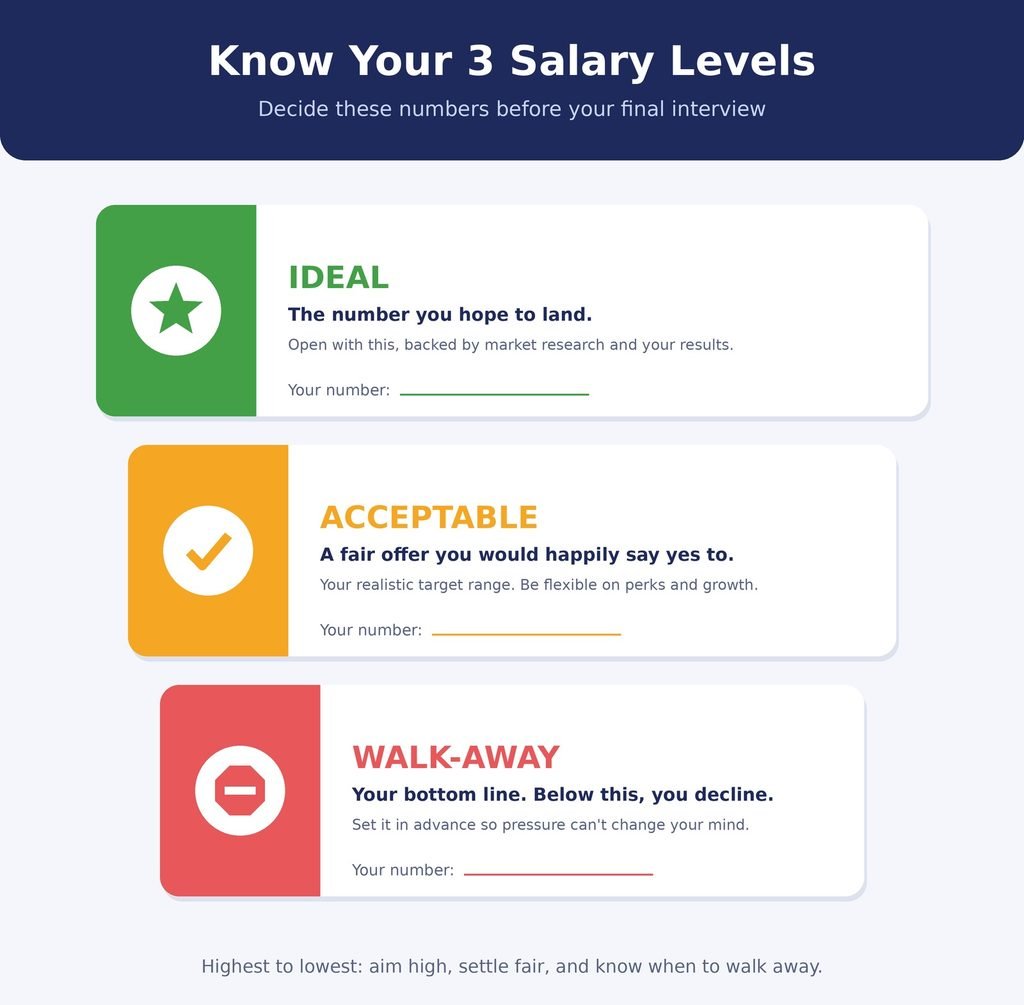
One important lesson I have learned from salary negotiations is that candidates should research their market value before sharing their expectations. I have seen good candidates lose opportunities because their expectations were far beyond the company’s budget, while others undervalued their skills. My advice is to negotiate confidently, but always support your expectations with experience, skills, and market data.
Step 6: Prepare Smart Questions to Ask the HR Manager
When the HR manager asks, “Do you have any questions for us?”, never say “No.” Good questions show you are serious and thinking long term.
Strong questions to ask:
- “What does success look like in this role in the first 90 days?”
- “How would you describe the team culture and management style?”
- “What training or growth opportunities does the company offer?”
- “What are the biggest challenges the person in this role will face?”
- “What are the next steps and expected timeline for the decision?”
Questions to avoid in the final round:
- “How many leaves do I get?” as your very first question
- “How soon can I get promoted?” before you have even joined
- Anything you could have found on the company website
Step 7: Master the Day of the Interview
Before you leave (or log in)
- Sleep well. A rested mind answers better than a memorized script.
- Print two copies of your CV and bring a notebook and pen.
- Carry original documents if requested: ID, certificates, experience letters.
- Plan your route and reach 15 minutes early. For online interviews, test your camera, microphone, and internet 20 minutes before.
Best CV Format for HR Professionals
First impressions
- Dress one level above the company’s usual dress code.
- Smile, greet everyone politely, including the receptionist. Their opinion is sometimes asked.
- Offer a firm (not crushing) handshake where culture allows it.
Body language and voice
- Sit upright and keep your hands visible and relaxed.
- Make natural eye contact. For video calls, look at the camera when speaking.
- Speak slowly. Pause for a second before answering. A pause looks thoughtful, not weak.
- If you do not understand a question, say, “Could you please repeat or explain that?” It is better than a wrong answer.

My Interview-Day Tip: Arrive Early and Stay Calm
One thing I always recommend to candidates is to prepare everything a day before the interview. Keep your CV copies, educational documents, CNIC, and any required certificates ready.
Try to reach the interview location 15–20 minutes early. I have seen candidates create unnecessary stress for themselves by arriving at the last minute.
As an HR professional, my advice is simple: your interview starts before you enter the interview room. Your punctuality, confidence, appearance, and attitude all create a first impression.
Take a deep breath, smile, and be yourself. You don’t need to be perfect; you just need to be prepared.
Step 8: Manage Your Nerves
Feeling nervous means you care. The goal is not to remove nerves but to control them.
- Breathe: Breathe in for four seconds, hold for four, and breathe out for six. Do it three times before you enter.
- Reframe the thought: Change “They will judge me” to “We are checking if we fit each other.”
- Remember your wins: Read three achievements from your CV before you walk in.
- Accept small mistakes: One weak answer will not ruin the interview. Move on calmly.
If you want more help, read our guide on managing anxiety before a job interview.
A Moment I Never Forget
During my experience in recruitment, I have met many talented candidates who struggled with nervousness during interviews. I remember seeing candidates who had strong qualifications and experience but became so nervous that they couldn’t express themselves properly.
One thing I learned is that sometimes candidates don’t lack knowledge; they simply lack confidence in that moment.
I always try to make candidates comfortable by starting with a simple conversation and giving them a few moments to settle down. A friendly smile and a supportive attitude can make a big difference.
My message to every job seeker is simple: Don’t let nervousness make you forget your abilities. The interviewer is also a human being. Take a breath, relax, and give yourself a chance. You deserve to be heard.
Step 9: Close Strong and Follow Up
The last two minutes matter. Many HR managers decide on the final impression.
How to close the interview:
- Briefly repeat your interest: “After speaking with you today, I am even more excited about this role.”
- Connect your skill to their need: “I believe my experience in payroll and recruitment can help your team from the start.”
- Ask about next steps and timing.
- Thank everyone by name.
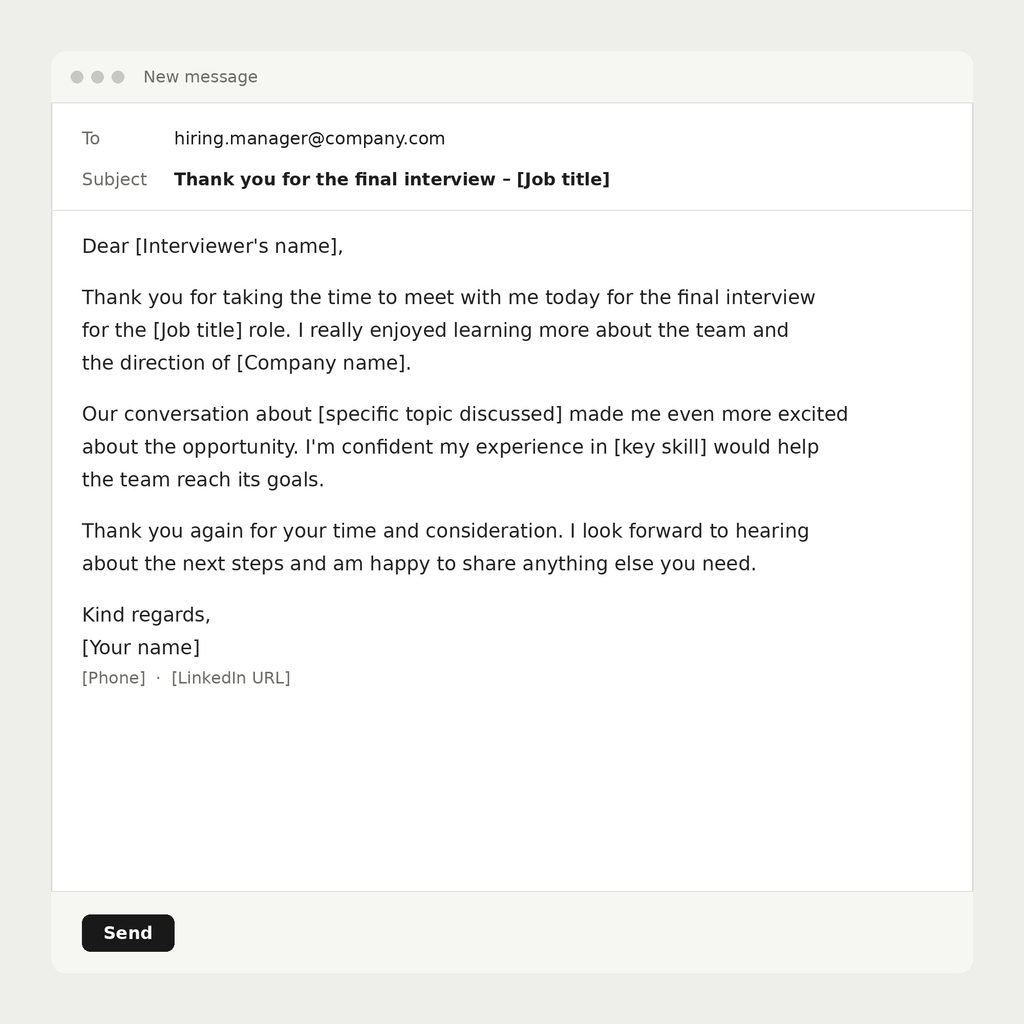
Send a thank-you email within 24 hours. Keep it short and sincere:
Subject: Thank you, [Position] Interview
Dear [HR Manager’s Name],
Thank you for taking the time to meet me today. I enjoyed learning more about the team and the goals of the department. Our conversation made me even more interested in the [Job Title] role, and I am confident my experience in [your skill] can add value.
Please let me know if you need any further information from me. I look forward to hearing from you.
Kind regards, [Your Name] [Phone number]
10 Mistakes That Can Cost You the Offer
| Mistake | What to do instead |
| Giving answers that contradict earlier rounds | Review your earlier interviews before the final round |
| Speaking badly about your old boss or company | Stay positive and focus on what you learned |
| Not knowing anything about the company | Research the website, values, and recent news |
| Saying “anything is fine” about salary | Prepare a realistic range |
| Having no questions to ask | Prepare at least three smart questions |
| Lying or exaggerating on your CV | Be honest. HR checks references |
| Looking at your phone or checking the time | Switch off notifications completely |
| Being too casual because “it’s the last round” | Stay professional until you leave the building |
| Not saying thank you | Send a short email within 24 hours |
| Giving up after one weak answer | Recover calmly and finish strong |
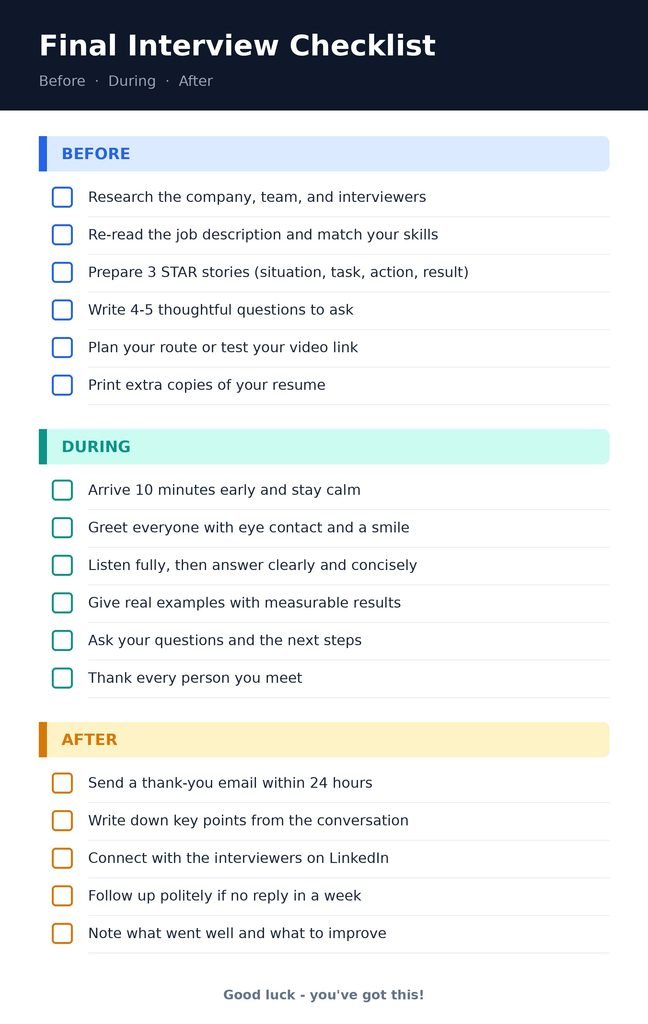
Final Interview Checklist
One week before
- Review the job description and earlier interview notes
- Prepare five STAR stories
- Research the company and the HR manager
One day before
- Choose and iron your outfit
- Print CV copies and prepare documents
- Prepare questions to ask
- Practice your answers aloud with a friend or mirror
Interview day
- Arrive 15 minutes early (or log in 10 minutes early online)
- Phone on silent
- Smile, listen carefully, and answer honestly
- Ask your questions and close with confidence
After the interview
- Send the thank-you email within 24 hours
- Note the questions asked for your own learning
- Be patient and follow up politely if you hear nothing after the promised date
Frequently Asked Questions
How long does a final interview with an HR manager usually last?
Most last between 30 and 60 minutes. Senior roles may take longer.
Does reaching the final interview mean I will get the job?
No. It means you are a strong candidate, but the company may still choose someone else or have concerns about fit, salary, or references. Treat it seriously.
Should I negotiate salary in the final interview?
Yes, politely, if the offer is discussed. Research the market first and be ready with a reasonable range. Focus on the full package, not only the base pay.
What if I do not know the answer to a question?
Be honest. Say what you do know, explain how you would find the answer, and show willingness to learn. HR managers value honesty over fake confidence.
How long should I wait before following up?
If the HR manager gave a timeline, wait until it passes, then send one polite follow-up email. If no timeline was given, follow up after five to seven working days.
Final Words
A final interview is not about being perfect. It is about being clear, honest, prepared, and human. Know your story, respect the process, ask good questions, and speak with calm confidence. If you do these things, you give the HR manager every reason to say yes.
Whether you get the offer or not, every final interview teaches you something. Keep learning, keep improving, and keep going.
If you are going for your final interview tomorrow, believe in yourself. You may not know the answer to every question, but your confidence, honesty, attitude, and willingness to learn can make a real difference.
I have seen many candidates succeed, and I have also seen good people lose opportunities simply because they doubted themselves. Remember, an interview is not just about getting a job; it is about showing people what you can bring to the table.
Stay confident, stay humble, and never underestimate your potential.
Best wishes,
Muhammad Faisal
HR Specialist
Disclaimer: This article is for general education and information. Hiring practices, labor laws, and company policies differ by country and employer, so adapt the advice to your situation. Sample answers are examples only; please personalize them with your own experience.

About Muhammad Faisal
Muhammad Faisal is an HR professional with an MBA in Human Resources and six years of experience across diverse HR domains. Through HRGuide.site, he turns real-world HR knowledge into practical insights, career advice, interview tips, and valuable resources to help professionals grow and organizations thrive.