
Workplace Harassment: Types, Laws and How to Report It
Harassment at work damages health, careers and entire teams. This guide explains every major type of workplace harassment, how the law protects you in different countries, and exactly what to do if it happens to you or someone you know.
Every worker deserves a workplace free from harassment.
What Is Workplace Harassment?
Workplace harassment is unwelcome behavior connected to work that offends, humiliates, intimidates or threatens a person, or makes it hard for them to do their job. It can take place in an office, a factory, a school, a hospital, a shop, a video meeting, on a business trip or at a work social event. The person responsible may be a boss, a coworker, a junior employee, a customer or a supplier.
Harassment is not “just a joke” and it is not “office culture.” Intent matters less than impact: if behavior is unwelcome and creates fear, shame or a hostile atmosphere, it can count as harassment.
At the international level, the International Labour Organization adopted the Violence and Harassment Convention (C190) in 2019. It is the first global treaty to set a framework for preventing and addressing violence and harassment at work, including gender-based violence and harassment. It protects not only regular employees but also interns, apprentices, volunteers, job applicants and others in the world of work. The treaty entered into force in June 2021, and by April 2026 about 55 countries had ratified it.
All Major Types of Workplace Harassment
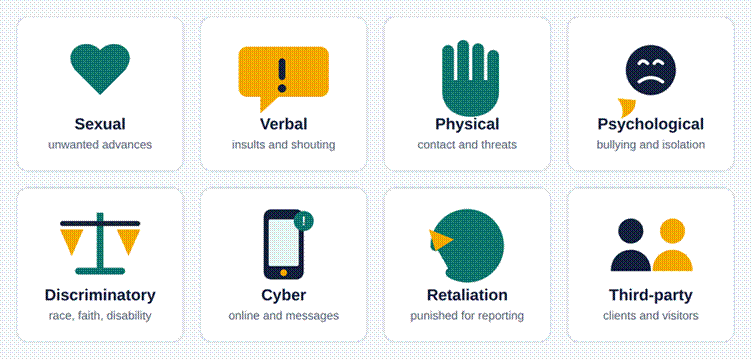
Eight common forms of workplace harassment.
1. Sexual harassment
- Unwanted touching, hugging or physical closeness
- Sexual jokes, comments about someone’s body or repeated requests for dates
- Sending inappropriate images, videos or messages
- Quid pro quo: demanding sexual favors in exchange for hiring, promotion or job security
- Hostile environment: constant sexual behavior that makes work uncomfortable
2. Gender-based harassment
Mistreatment because of a person’s gender, such as sexist remarks, exclusion from meetings, or treating pregnant employees unfairly.
3. Verbal harassment
Insults, shouting, name-calling, mocking someone’s accent or appearance, and humiliating a person in front of others.
4. Physical harassment
Pushing, hitting, blocking someone’s path, or any threat of physical harm.
5. Psychological harassment and bullying
Constant criticism, deliberate isolation, spreading rumors, impossible deadlines, removing responsibilities without reason, or threats used to control someone.
6. Discriminatory harassment
Harassment based on race, color, religion, nationality, ethnicity, caste, disability, age, sexual orientation, gender identity or marital status.
7. Cyber harassment
Offensive emails or chats, unwanted calls, online stalking, fake accounts, or sharing private photos or personal data without consent.
8. Retaliation
Punishing someone for reporting harassment or for helping a colleague with a complaint. In many countries retaliation is a separate legal violation, even if the original complaint is not proven.
9. Third-party harassment
Harassment by customers, clients, patients, visitors or contractors. Many employers are legally expected to protect staff from this too.
10. Remote-work harassment
Inappropriate behavior on video calls, late-night messages, or monitoring that crosses personal boundaries.
Warning Signs
- The behavior continues after you have asked the person to stop
- Your job, pay or schedule suddenly changes after you refuse someone
- You are left out of meetings or opportunities without explanation
- You feel anxious, afraid or unwell before going to work
- Colleagues avoid the topic or warn you to “just stay quiet”
Workplace Harassment Laws Around the World
Every country has its own rules, but most share the same core ideas: employers must prevent harassment, investigate complaints fairly, and never punish people for reporting. The table below gives a short overview. Always confirm details with an official source in your country, because laws and deadlines change.
| Country or region | Main law or framework | Where complaints can go |
| International | ILO Violence and Harassment Convention (C190), 2019 | Applies once a country ratifies and passes national laws |
| United States | Title VII of the Civil Rights Act and related federal and state laws | Employer, then the Equal Employment Opportunity Commission (EEOC) or state agency |
| United Kingdom | Equality Act 2010, with a duty on employers to take reasonable steps to prevent sexual harassment | Internal grievance, ACAS early conciliation, then employment tribunal |
| European Union | EU equality directives, plus national laws in each member state | Employer, labor inspectorate, equality body or court |
| Canada | Federal and provincial labor and human rights laws | Employer, labor authority or human rights commission |
| Australia | Sex Discrimination Act and Fair Work laws, with a positive duty on employers | Australian Human Rights Commission or Fair Work Commission |
| India | Sexual Harassment of Women at Workplace (Prevention, Prohibition and Redressal) Act, 2013 | Internal Committee or Local Committee |
| Pakistan | Protection against Harassment of Women at the Workplace Act, 2010 (amended 2022) | Inquiry Committee, then the Ombudsperson |
| Other regions | Labor codes, criminal laws or specific harassment acts (still being strengthened in many countries) | Labor ministry, ombudsman, police or courts |
Tip: Search for “your country + workplace harassment law” together with “labor ministry” or “ombudsman” to find official, current guidance. Time limits to file a complaint can be short, sometimes only a few months.
How to File a Workplace Harassment Complaint
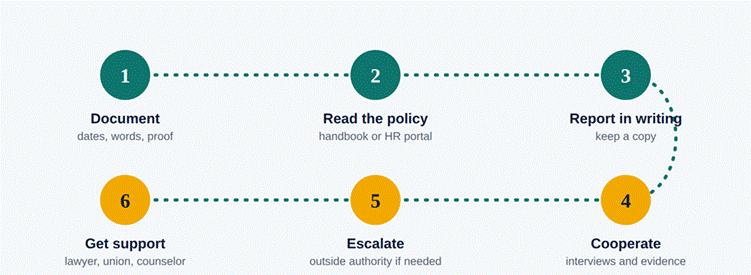
The six steps of a harassment complaint.
- Document everything. Record dates, times, locations, exact words, witnesses and how you reacted. Save emails, messages, screenshots and call logs in a safe place outside company systems.
- Read your company policy. Find the anti-harassment or grievance procedure in your handbook or HR portal and note who handles complaints.
- Report in writing. Send a clear, factual complaint to HR, a trusted manager or the designated committee. Describe what happened, who was involved and what outcome you want. Keep a copy.
- Cooperate with the investigation. Expect interviews, requests for evidence and a chance for both sides to respond. Ask how long the process will take and who will see your information.
- Escalate if needed. If the employer does nothing or retaliates, contact an external body such as a labor inspectorate, human rights commission, equality body, ombudsman or court. Check the filing deadline early.
- Get support. Speak to a lawyer, trade union, legal-aid group, workers’ rights organization or counselor. You do not have to handle this alone.
A Real Case from My Experience
During my work in HR, I came across a case that taught me how important it is to listen without judgment. A female colleague in our Finishing Department had been going through a period of unwelcome behavior from a senior colleague. She was silent about it for a long time because she feared that speaking up would affect her job and her reputation.
I noticed she had become withdrawn and was avoiding meetings / certain areas of the office. I did not push her. I simply asked if she was okay and told her that she could talk to me privately. After a few days, she felt safe enough to share what had been happening.
I listened carefully, and I told her three things: it was not her fault, she was not alone, and she had the right to report it. I explained the complaint process, helped her understand what to write down, and encouraged her to keep dates, messages and the names of anyone who had seen the behavior.
With that support, she gathered the courage to file a written complaint. [The company formed an inquiry committee / The matter was handled through HR.] The process was [outcome in general terms, for example: handled confidentially and the behavior was addressed].
What stayed with me was how small the first step really was. She did not need a speech. She needed someone who listened, believed her, and showed her the way.
What I learned:
- Notice changes in behavior and check in quietly and respectfully.
- Listen first, and never blame the person who is speaking up.
- Explain the process clearly so they know what to expect.
- Support them, but let them make the decision to report.
Note: Details in this story have been changed to protect everyone’s privacy
Your safety comes first. If you feel in danger, move to a safe place and contact the police or local emergency services.
What Employers Should Do
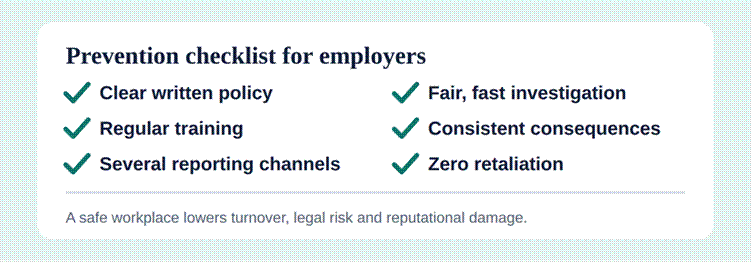
Prevention checklist for employers and HR teams.
- Write a clear anti-harassment policy and explain it to every employee, including new hires
- Offer several reporting channels, including one that does not go through a direct manager
- Train managers and staff regularly, with realistic examples
- Investigate quickly, fairly and confidentially
- Apply consistent consequences regardless of the harasser’s rank or performance
- Protect complainants and witnesses from retaliation
- Review complaint data and workplace culture at least once a year
What Colleagues and Bystanders Can Do
- Do not laugh at or ignore inappropriate behavior
- Check in privately with the affected person and ask what support they want
- Offer to act as a witness if they choose to report
- Report what you see if your workplace policy requires it
- Never gossip about the person who complained
Myths and Facts
| Myth | Fact |
| It must involve physical contact. | Words, images, gestures and online messages count too. |
| It only counts if it happens many times. | One serious incident can be enough. |
| Only women are harassed. | Anyone can be affected, and many laws protect all genders. |
| Reporting will ruin my career. | Retaliation is illegal in many countries, and protection exists. |
| If I did not object, it was fine. | Fear of losing a job can stop people from speaking up. Silence is not consent. |
Frequently Asked Questions
Can I report harassment from a client or customer?
Yes. In many countries employers have a duty to protect workers from third parties, so tell your employer in writing.
Do I need proof to file a complaint?
Evidence helps, but your detailed account and any witnesses also matter. Do not wait to collect “perfect” proof before asking for help.
What if my boss is the harasser?
Use another channel: HR, a senior leader, a complaints committee or an external authority such as a labor inspectorate or ombudsman.
Does harassment have to happen at the office?
No. It can happen online, at work events, on trips or anywhere connected to work.
Can men and LGBTQ+ employees file complaints?
Yes. Many countries’ laws protect people regardless of gender or sexual orientation. Check the wording of the law where you work.
How long do I have to file a complaint?
It varies by country and type of complaint. Some deadlines are only a few months, so check early and keep your records.
Conclusion
Everyone deserves a workplace free from fear, humiliation and abuse. Knowing the types of harassment, keeping careful records, and understanding the protections in your country gives you real power to act. Employers who build respectful workplaces also gain lower turnover, higher trust and stronger teams.
If you are experiencing harassment, remember that it is not your fault, and you are not alone.
Disclaimer: This article is for general information only and is not legal advice. Laws differ by country and change over time. For help with a specific situation, consult a qualified lawyer, labor authority or workers’ rights organization.

About Muhammad Faisal
Muhammad Faisal is an HR professional with an MBA in Human Resources and six years of experience across diverse HR domains. Through HRGuide.site, he turns real-world HR knowledge into practical insights, career advice, interview tips, and valuable resources to help professionals grow and organizations thrive.