
Managing Anxiety Before a Job Interview: A Practical Guide
Why Do We Feel Anxious Before Interviews?
An interview combines several things the human mind finds stressful: being judged, facing the unknown, and having something important at stake, such as income, stability or a career move.
When your brain senses a threat, it releases stress hormones. This is the same “fight or flight” response that helps people react quickly in danger. In an interview room, it simply makes you feel shaky, sweaty and forgetful, even though there is no real danger.
Common reasons people feel nervous include:
- Fear of being rejected or not being good enough
- Not knowing what questions will be asked
- Past bad interview experiences
- Long periods without a job, which add financial pressure
- Comparing yourself with other candidates
- Wanting to be perfect
Common Signs of Interview Anxiety
Anxiety shows up differently in different people. You may notice:
- A racing heart, sweaty palms or a dry mouth
- A tight chest or upset stomach
- Trouble sleeping the night before
- Racing or negative thoughts such as “I will mess this up”
- Difficulty concentrating or going blank
- Speaking too fast, or avoiding eye contact
Recognizing these signs early helps you respond calmly instead of feeling surprised by them.
Before the Interview: Build Confidence Through Preparation
Uncertainty feeds anxiety, so the best way to reduce it is to remove as much uncertainty as you can.
1. Learn about the company. Read the company website, its main products or services, and its recent news. Knowing who you are talking to makes the conversation feel familiar.
2. Study the job description. Highlight the main skills required. For each one, think of a real example from your work, studies or projects that shows you can do it.
3. Practice common questions out loud. Questions like “Tell me about yourself,” “Why do you want this job?” and “What are your strengths and weaknesses?” appear in most interviews. Speaking your answers aloud, in front of a mirror or with a friend, is far more effective than only thinking about them.
4. Prepare a few stories. Choose three or four real situations where you solved a problem, worked in a team, or learned from a mistake. You can adapt these stories to many different questions.
5. Prepare questions to ask. Having two or three thoughtful questions about the role or team shows interest and gives you something active to do when the interview is nearly over.
6. Plan the practical details. Check the location or video link, your route, travel time and what you will wear. A calm morning starts with decisions made the day before.
The Night Before
- Keep your documents ready: copies of your CV, certificates and ID.
- Avoid last-minute cramming. Do one light review, then stop.
- Go to bed at a reasonable time. Rest improves memory and mood more than an extra hour of worry.
- If your mind keeps racing, write your worries on paper. Seeing them written down often makes them smaller.
On the Day: Calming Your Body and Mind
Slow your breathing
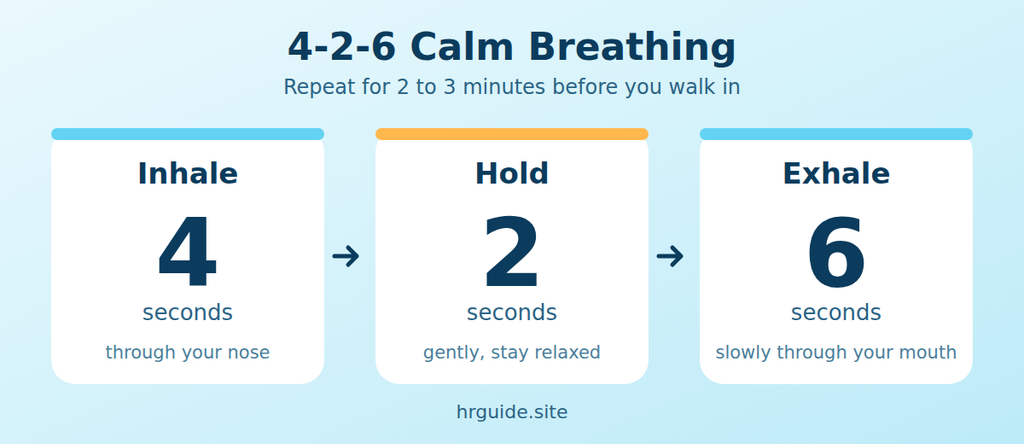
Breathing slowly signals your body that it is safe. Try this simple method for two or three minutes before you go in:
- Breathe in gently through your nose for 4 seconds.
- Hold for 2 seconds.
- Breathe out slowly through your mouth for 6 seconds.
- Repeat several times.
The longer out-breath is what helps you settle.
Ground yourself in the present
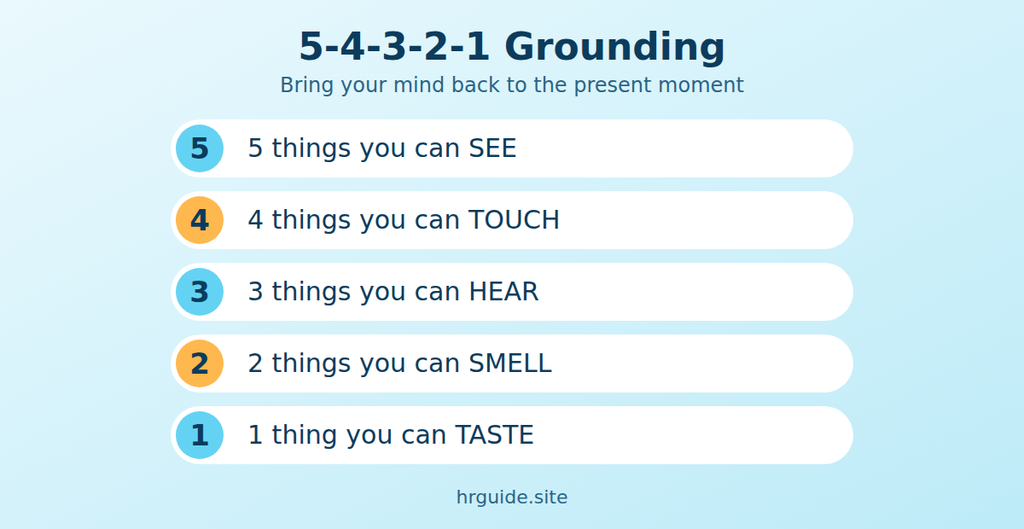
If your thoughts are racing ahead, bring your attention back to the room. Quietly notice five things you can see, four you can touch, three you can hear, two you can smell and one you can taste. This pulls your mind away from “what if” thoughts.
Change your self-talk
Replace harsh thoughts with realistic ones:
- Instead of “I am going to fail,” try “I have prepared, and I will do my best.”
- Instead of “They will see I am nervous,” try “Being a little nervous is normal, and interviewers expect it.”
- Instead of “I must be perfect,” try “I only need to be honest and clear.”
Arrive early, not too early
Reach the place 10 to 15 minutes before the time. This gives you a moment to relax without sitting in the waiting area for too long and building up tension.
During the Interview
- Pause before answering. Taking two or three seconds to think is perfectly acceptable and sounds thoughtful, not weak.
- Speak slowly. Nerves make us rush. A slower pace sounds more confident.
- Ask for clarification. If you do not understand a question, politely ask the interviewer to repeat or explain it.
- It is okay to say you need a moment. If your mind goes blank, say, “That is a good question, let me think for a moment.” Then breathe and answer.
- Be honest. If you do not know something, say so and explain how you would find the answer. Honesty is respected far more than a made-up reply.
- Treat it as a conversation. The interviewer is also trying to see if the job suits you. You are both exploring a fit.
After the Interview
Many people spend hours replaying every sentence they said. Try this instead:
- Write down what went well and what you would improve next time.
- Send a short thank-you email within a day.
- Do something relaxing, like a walk or time with family.
- Remember that the decision depends on many factors you cannot control, including other candidates and internal needs.
Even if you are not selected, each interview is practice that makes the next one easier.
Mistakes That Increase Anxiety
- Trying to memorize answers word for word. It makes you panic if you forget one line.
- Comparing yourself with other candidates in the waiting area.
- Having too much coffee or skipping meals before the interview.
- Staying up late studying.
- Telling yourself that this is your only chance. There are always other opportunities.
Quick Checklist
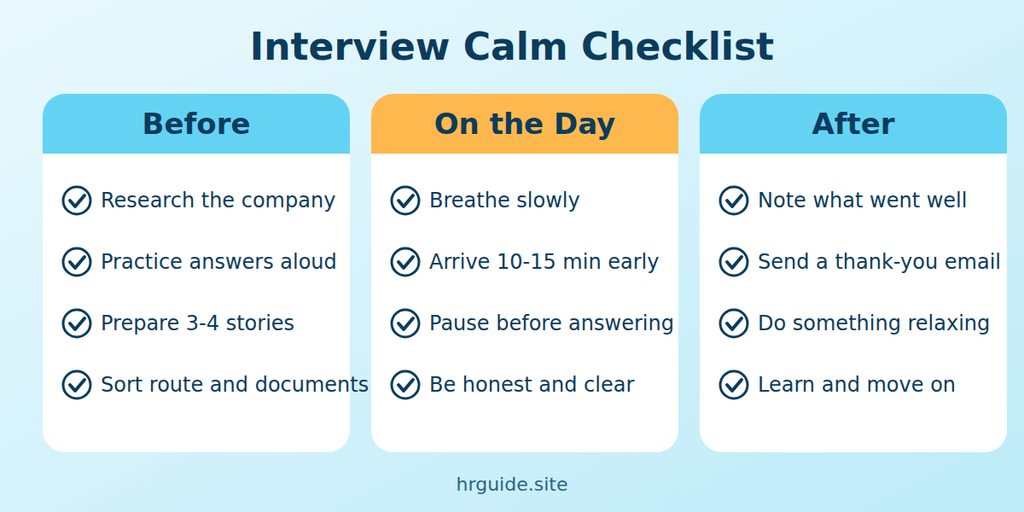
- ☐ Research the company and the role
- ☐ Practice answers aloud
- ☐ Prepare 3 to 4 stories from real experience
- ☐ Prepare 2 to 3 questions to ask
- ☐ Sort out route, documents and clothes the night before
- ☐ Sleep well and eat a light meal
- ☐ Practice slow breathing before you go in
- ☐ Reflect and send a thank-you note afterwards
Key Takeaways
- Interview nerves are normal and do not mean you will fail.
- Preparation is the strongest tool against anxiety.
- Slow breathing and positive, realistic self-talk calm the body and mind.
- Pausing, asking for clarification and being honest help you stay in control.
- Every interview, successful or not, builds your confidence for the next one.
Note: This article offers general guidance for everyday interview nerves. If anxiety is severe, constant or affects your daily life, consider speaking with a qualified health professional.
Related Reading
- How to Build Self-Confidence Before an Interview
- What to Do When You Freeze During an Interview
- Handling Rejection After an Interview With a Healthy Mindset
A rejection is not the end of the world.
Every rejection I’ve ever gotten led me to an offer I was actually meant to have. I just couldn’t see that while I was in it.
I used to spend so much time prepping for interviews, and a lot of that prep was really just anxiety. Looking back, I don’t think I was scared of the job in particular, I was just terrified of not getting the job.
So I’d tell myself to spend less time stressing about that and more time figuring out whether the job was right for me.
Because once you stop trying to be perfect, you can interview the company back. That’s the part I missed.
Do the prep work. Absolutely it matters.

About Muhammad Faisal
Muhammad Faisal is an HR professional with an MBA in Human Resources and six years of experience across diverse HR domains. Through HRGuide.site, he turns real-world HR knowledge into practical insights, career advice, interview tips, and valuable resources to help professionals grow and organizations thrive.